CAST: Calibrating Correspondences for Training-Free Biomedical In-Context Segmentation
Abstract
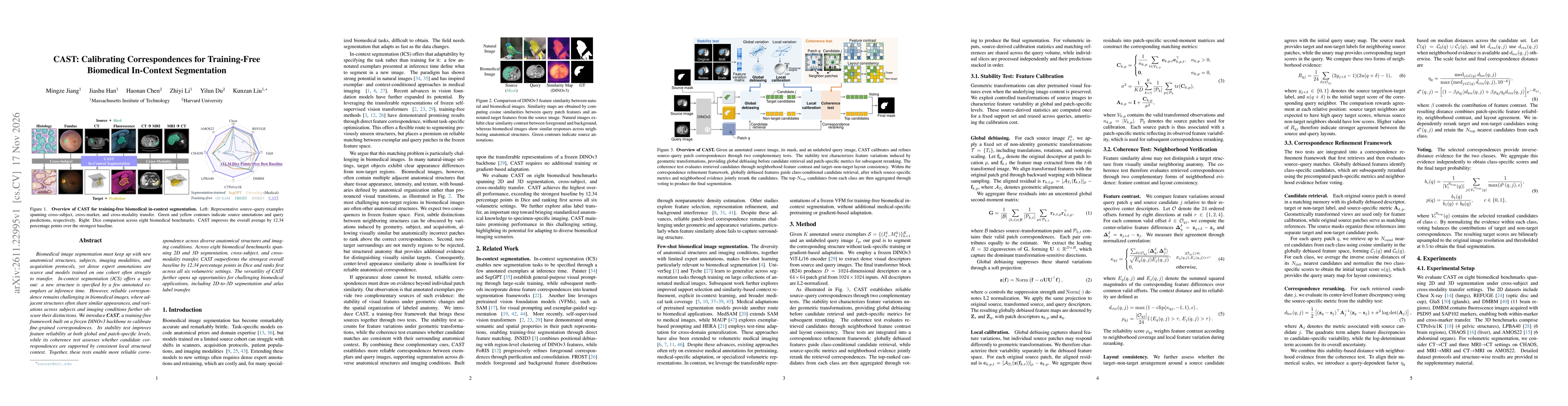
Biomedical image segmentation must keep up with new anatomical structures, subjects, imaging modalities, and acquisition protocols, yet dense expert annotations are scarce and models trained on one cohort often struggle to transfer. In-context segmentation (ICS) offers a way out: a new structure is specified by a few annotated exemplars at inference time. However, reliable correspondence remains challenging in biomedical images, where adjacent structures often share similar appearances, and variations across subjects and imaging conditions further obscure their distinctions. We introduce CAST, a training-free framework built on a frozen DINOv3 backbone to calibrate fine-grained correspondences. Its stability test improves feature reliability at both global and patch-specific levels, while its coherence test assesses whether candidate correspondences are supported by consistent local structural context. Together, these tests enable more reliable correspondence across diverse anatomical structures and imaging conditions. Across eight biomedical benchmarks spanning 2D and 3D segmentation, cross-subject, and cross-modality transfer, CAST outperforms the strongest overall baseline by 12.34 percentage points in Dice and ranks first across all six volumetric settings. The versatility of CAST further opens up opportunities for challenging biomedical applications, including 2D-to-3D segmentation and atlas label transfer.
AI Key Findings
Get AI-generated insights about this paper's methodology, results, significance, and more — available when analysis has been generated.
Discussion 0