CatRetriever: Contrastive Representation Learning for Slab-to-Bulk Retrieval in Generative Catalyst Discovery
CatRetriever is a contrastive learning method that links slab (surface) structures to their parent bulk crystals in a shared latent space, enabling accurate bulk retrieval from a surface query (R@1 > 91%, R@3 > 98%). It also enables a pipeline that combines bulk retrieval with generative search and adsorption-energy analysis to identify bulk catalysts that are both structurally compatible with a given surface and capable of achieving target adsorption energies.
Abstract
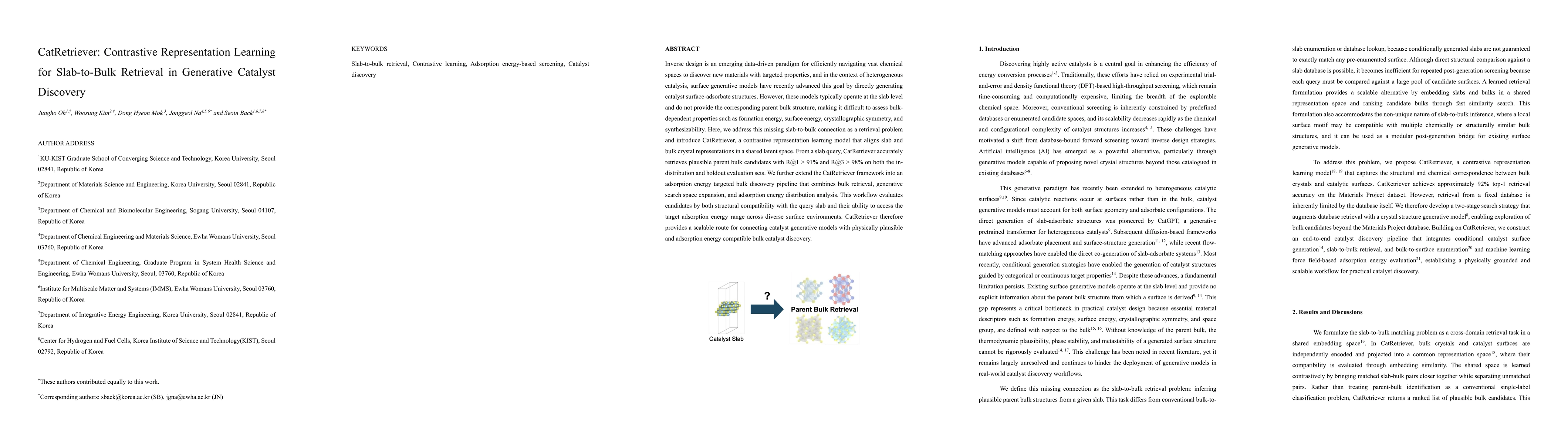
Inverse design is an emerging data-driven paradigm for efficiently navigating vast chemical spaces to discover new materials with targeted properties, and in the context of heterogeneous catalysis, surface generative models have recently advanced this goal by directly generating catalyst surface-adsorbate structures. However, these models typically operate at the slab level and do not provide the corresponding parent bulk structure, making it difficult to assess bulk-dependent properties such as formation energy, surface energy, crystallographic symmetry, and synthesizability. Here, we address this missing slab-to-bulk connection as a retrieval problem and introduce CatRetriever, a contrastive representation learning model that aligns slab and bulk crystal representations in a shared latent space. From a slab query, CatRetriever accurately retrieves plausible parent bulk candidates with R@1 > 91% and R@3 > 98% on both the in-distribution and holdout evaluation sets. We further extend the CatRetriever framework into an adsorption energy targeted bulk discovery pipeline that combines bulk retrieval, generative search space expansion, and adsorption energy distribution analysis. This workflow evaluates candidates by both structural compatibility with the query slab and their ability to access the target adsorption energy range across diverse surface environments. CatRetriever therefore provides a scalable route for connecting catalyst generative models with physically plausible and adsorption energy compatible bulk catalyst discovery.
AI Key Findings
Get AI-generated insights about this paper's methodology, results, significance, and more — available when analysis has been generated.
Discussion 0