Causal Overtaking in Fair Transaction Ordering
Abstract
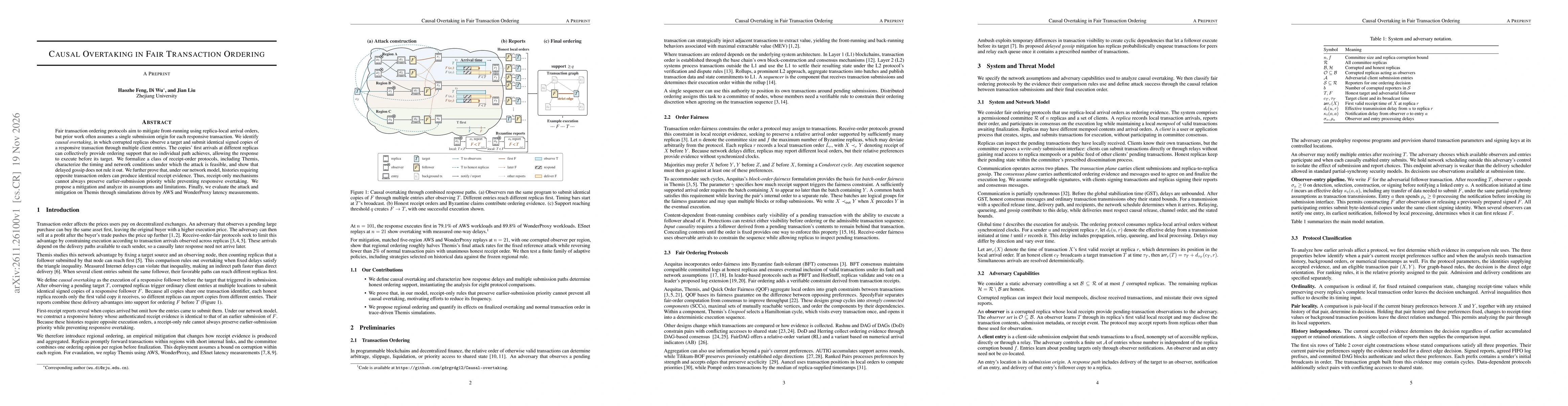
Fair transaction ordering protocols aim to mitigate front-running using replica-local arrival orders, but prior work often assumes a single submission origin for each responsive transaction. We identify causal overtaking, in which corrupted replicas observe a target and submit identical signed copies of a responsive transaction through multiple client entries. The copies' first arrivals at different replicas can collectively provide ordering support that no individual path achieves, allowing the response to execute before its target. We formalize a class of receipt-order protocols, including Themis, characterize the timing and network conditions under which the attack is feasible, and show that delayed gossip does not rule it out. We further prove that, under our network model, histories requiring opposite transaction orders can produce identical receipt evidence. Thus, receipt-only mechanisms cannot always preserve earlier-submission priority while preventing responsive overtaking. We propose a mitigation and analyze its assumptions and limitations. Finally, we evaluate the attack and mitigation on Themis through simulations driven by AWS and WonderProxy latency measurements.
Analysis
AI-generated · verify against the original paper
Generated Jan 1, 0001ResultsWhat the authors found
- The causal overtaking attack causes the responsive transaction to execute before its target in 79.1% of AWS workloads and 89.8% of WonderProxy workloads.
- Regional ordering mitigation roughly halves Themis's final attack rates while reversing fewer than 2% of normal transaction pairs.
- Simulations on ESnet workloads also demonstrate overtaking under measured one-way delays.
LimitationsWhere the findings need caution
- The mitigation assumes a bounded number of corrupted replicas within each region.
- Evaluation is based on simulations with synthetic latency traces rather than live blockchain deployments.
MethodologyHow the work was done
We formalize a class of receipt-order protocols (including Themis), characterize timing and network conditions for causal overtaking, prove receipt-only mechanisms cannot always preserve earlier-submission priority, propose a regional ordering mitigation, and evaluate the attack and mitigation via trace-driven simulations using AWS, WonderProxy, and ESnet latency measurements.
SignificanceWhy the work matters
The work reveals a fundamental limitation of receipt-only fair ordering protocols, showing that they cannot guarantee earlier-submission priority against coordinated multi‑path attacks, thereby influencing the design of secure transaction ordering mechanisms.
Technical contributionsWhat the work introduces
A formal model and impossibility proof for receipt-only ordering, the construction of the causal overtaking attack, a regional ordering mitigation scheme, and a comprehensive simulation-based evaluation of both attack and mitigation.
NoveltyHow it differs from prior work
Identification and formalization of causal overtaking, an attack that leverages multiple client entries and receipt aggregation to bypass fair ordering guarantees.
Future workQuestions that remain
- Investigate adaptive policies and broader network models to further reduce overtaking.
- Validate the mitigation in real-world blockchain settings.
- Explore alternative designs that do not rely on receipt-only evidence.
Discussion 0