CausalDrive: Causal Decomposition for Data-Efficient End-to-End Autonomous Driving
Abstract
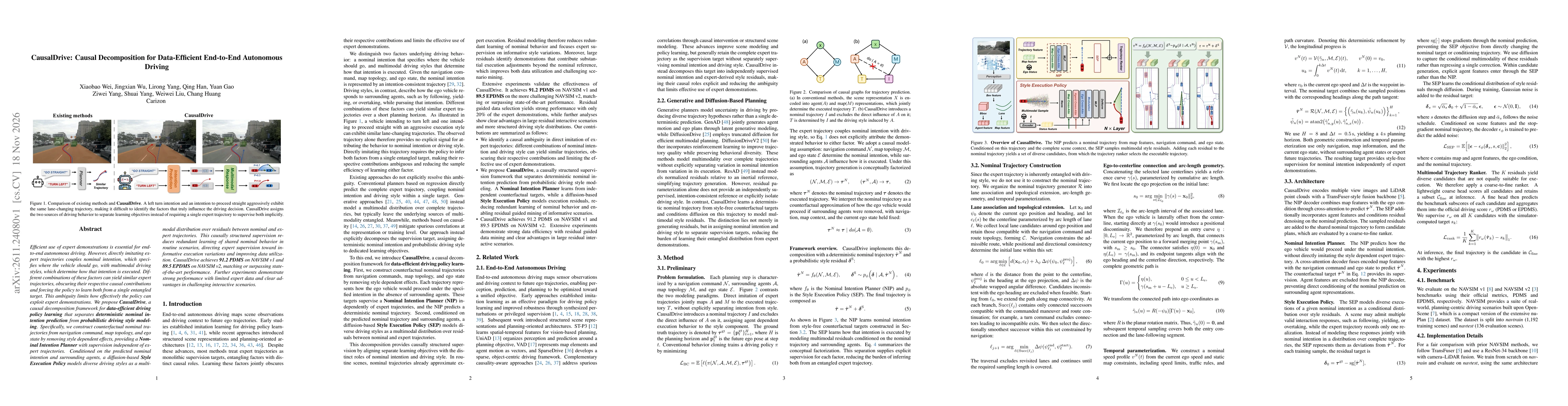
Efficient use of expert demonstrations is essential for end-to-end autonomous driving. However, directly imitating expert trajectories couples nominal intention, which specifies where the vehicle should go, with multimodal driving styles, which determine how that intention is executed. Different combinations of these factors can yield similar expert trajectories, obscuring their respective causal contributions and forcing the policy to learn both from a single entangled target. This ambiguity limits how effectively the policy can exploit expert demonstrations. We propose CausalDrive, a causal decomposition framework for data-efficient driving policy learning that separates deterministic nominal intention prediction from probabilistic driving style modeling. Specifically, we construct counterfactual nominal trajectories from navigation command, map topology, and ego state by removing style dependent effects, providing a Nominal Intention Planner with supervision independent of expert trajectories. Conditioned on the predicted nominal intention and surrounding agents, a diffusion-based Style Execution Policy models diverse driving styles as a multimodal distribution over residuals between nominal and expert trajectories. This causally structured supervision reduces redundant learning of shared nominal behavior in routine scenarios, directing expert supervision toward informative execution variations and improving data utilization. CausalDrive achieves 91.2 PDMS on NAVSIM v1 and 89.5 EPDMS on NAVSIM v2, matching or surpassing state-of-the-art performance. Further experiments demonstrate strong performance with limited expert data and clear advantages in challenging interactive scenarios.
Analysis
AI-generated · verify against the original paper
Generated Jan 1, 0001ResultsWhat the authors found
- Achieves 91.2 PDMS on NAVSIM v1 and 89.5 EPDMS on NAVSIM v2, matching or surpassing state-of-the-art performance.
- Demonstrates strong data efficiency, attaining comparable performance with only 20% of expert demonstrations via residual-guided data selection.
- Shows clear advantages in challenging interactive scenarios with large residuals, indicating better handling of diverse driving styles.
MethodologyHow the work was done
CausalDrive decomposes driving supervision into deterministic nominal intention prediction and probabilistic driving style modeling. Counterfactual nominal trajectories are generated from navigation commands, map topology, and ego state, training a Nominal Intention Planner independent of expert data. A diffusion-based Style Execution Policy then models a multimodal distribution over residuals between nominal and expert trajectories conditioned on the predicted intention and surrounding agents.
SignificanceWhy the work matters
By separating intention and style, CausalDrive reduces redundant learning of nominal behavior, focuses expert supervision on informative execution variations, and improves data utilization, advancing the efficiency and robustness of end-to-end autonomous driving systems.
Technical contributionsWhat the work introduces
Introduces a causal decomposition framework that uses counterfactual nominal trajectory generation and a diffusion-based residual modeling policy to disentangle and jointly learn intention and style, enabling data-efficient policy training.
NoveltyHow it differs from prior work
First work to apply causal decomposition with counterfactual nominal trajectories and diffusion residual modeling for end-to-end autonomous driving, explicitly addressing the entanglement of intention and style in imitation learning.
Discussion 0