Certifying the Error-Detection Value of Functional Dependencies without Ground Truth
Abstract
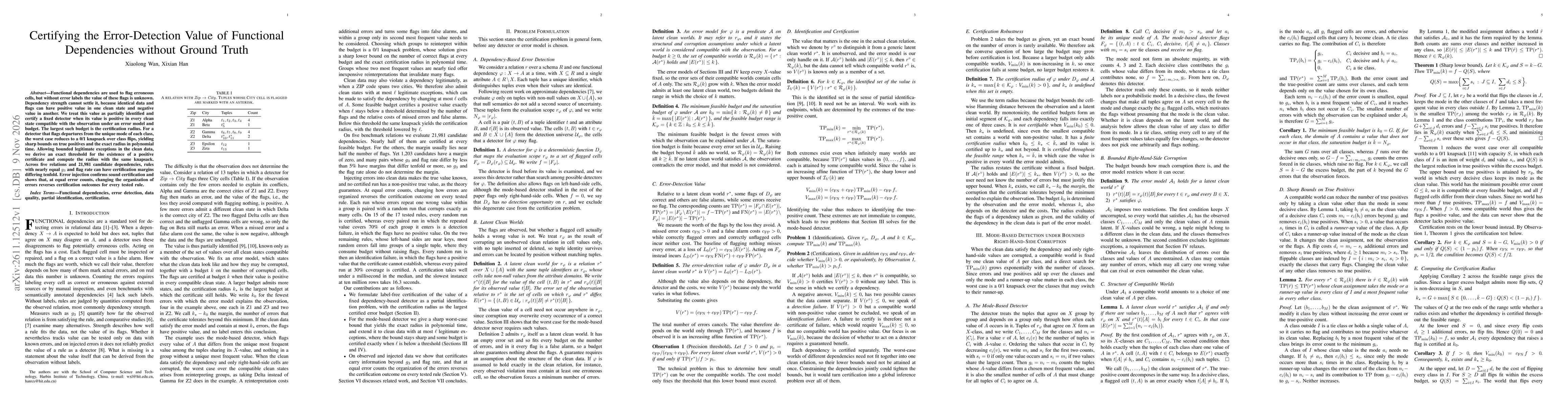
Functional dependencies are used to flag erroneous cells, but without error labels the value of these flags is unknown. Dependency strength cannot settle it, because identical data and flags can have positive value in one clean state and negative value in another. We treat this value as partially identified and certify a fixed detector when its value is positive in every clean state compatible with the observation under an error model and budget. The largest such budget is the certification radius. For a detector that flags departures from the unique mode of each class, the worst case reduces to a 0/1 knapsack over class flips, yielding sharp bounds on true positives and the exact radius in polynomial time. Allowing bounded legitimate exceptions in the clean data, we derive an exact threshold for the existence of a positive certificate and compute the radius with the same knapsack. Across five relations and 21,981 candidate dependencies, rules with nearly equal $g_3$ and flag rate can have certification margins differing tenfold. Error injection confirms sound certification and shows that, at equal error counts, changing the organization of errors reverses certification outcomes for every tested rule.
Analysis
AI-generated · verify against the original paper
Generated Jan 1, 0001ResultsWhat the authors found
- The knapsack reduction yields exact certification radii and sharp lower bounds on true positives in polynomial time.
- Across five benchmark relations and 21,981 candidate dependencies, certification margins can differ by up to tenfold even when g3 and flag rates are nearly equal.
- Error‑injection experiments confirm that certified detectors never have a negative true value and that reorganizing errors at equal counts reverses certification outcomes for every tested rule.
- Median certification time is well under one millisecond, with the largest instance (≈16.3 s for a million‑row table) still tractable.
LimitationsWhere the findings need caution
- The analysis is limited to the mode‑based detector that flags only right‑hand‑side cells.
- The error model assumes a fixed budget and bounded legitimate exceptions, which may not capture all real‑world error patterns.
- Experiments are confined to five relations and a specific set of candidate dependencies, leaving broader scalability untested.
MethodologyHow the work was done
The authors formulate label‑free certification of a fixed functional‑dependency detector as a partial‑identification problem, define the certification radius as the largest error budget for which the detector’s value is guaranteed positive, and show that for the mode‑based detector the worst case reduces to a 0/1 knapsack over class flips, enabling exact polynomial‑time computation of sharp true‑positive bounds and the radius; they also extend the approach to allow a bounded number of legitimate exceptions.
SignificanceWhy the work matters
This work provides the first method to assess the value of functional‑dependency error‑detection without any ground‑truth labels, offering guarantees that complement traditional strength measures (g3, flag rate) and enabling reliable use of FD‑based detectors in unlabeled data cleaning scenarios.
Technical contributionsWhat the work introduces
A formal label‑free certification framework for FD‑based error detectors, an exact knapsack‑based algorithm for computing the certification radius, and an extension handling bounded legitimate exceptions with a derived threshold for positive certification.
NoveltyHow it differs from prior work
Introducing partial‑identification certification of detector value without ground truth and reducing the worst‑case analysis to a solvable knapsack problem, which had not been applied to functional‑dependency error detection before.
Future workQuestions that remain
- Extending certification to detectors that also flag left‑hand‑side attributes, where the partition itself becomes latent.
- Incorporating joint constraints from multiple dependencies to tighten compatible clean‑state families.
- Exploring richer error models and larger‑scale evaluations beyond the current benchmark set.
Discussion 0