CIDERS: Cloud-Edge LLM Collaborative Learning via Accelerating Personalized Bilevel Optimization
Abstract
Amid the rapid advancement of physical-world intelligence, cloud-edge collaborative large language models (LLMs) have emerged as a promising roadmap for practical LLM deployment. However, existing cloud-edge paradigms struggle to balance global consensus with local personalization, which fails to satisfy the need for a unified knowledge foundation on the cloud and domain-specific adaptation at the edge. To address this, we introduce, for the first time, a personalized bilevel optimization framework that formalizes cloud-edge LLM collaboration as a dual structure: the upper level optimizes edge-side personalization, while the lower level governs cloud-side knowledge transfer, reaching cloud-edge evolving in coordination. We then propose CIDERS, an efficient solver that decomposes the model into a learnable backbone and a messenger. While the cloud performs knowledge transfer to the learnable backbone, the key lies in embedding global trajectories into each local personalization step via consensus-variate correction to reconcile personalization with consensus. We provide a comprehensive theoretical analysis, including a geometric characterization of the local trajectory and a full convergence guarantee, revealing an explicit trade-off structure between personalization and global convergence. Extensive experiments demonstrate that CIDERS consistently outperforms competitive baselines on the compressed edge path, with 3.1x and 1.7x gains on mathematical reasoning and code generation, respectively, and a 10\% relative gain on instruction metrics. Mechanism experiments attribute these gains to early consensus-corrected coordination and task-aware distillation. Overall, CIDERS offers a viable path toward consensus-guided continuous personalization in cloud-edge LLM systems.
Analysis
AI-generated · verify against the original paper
Generated Jan 1, 0001ResultsWhat the authors found
- CIDERS improves GSM8K accuracy on Qwen2.5‑3B by 11.15 percentage points over state‑of‑the‑arts.
- CIDERS achieves up to 200%+ accuracy gains and the best Dolly PPL, ROUGE‑L, and HumanEval‑X scores among compressed methods.
- Control‑state diagnostics show strong preservation of the local orthogonal component, and cross‑domain evaluation reveals only a small matched‑domain advantage.
LimitationsWhere the findings need caution
- The lower‑level distillation introduces approximation error that must be carefully controlled to avoid dominating upper‑level progress.
- Large local step sizes can inflate client drift and may cause divergence if not properly bounded.
MethodologyHow the work was done
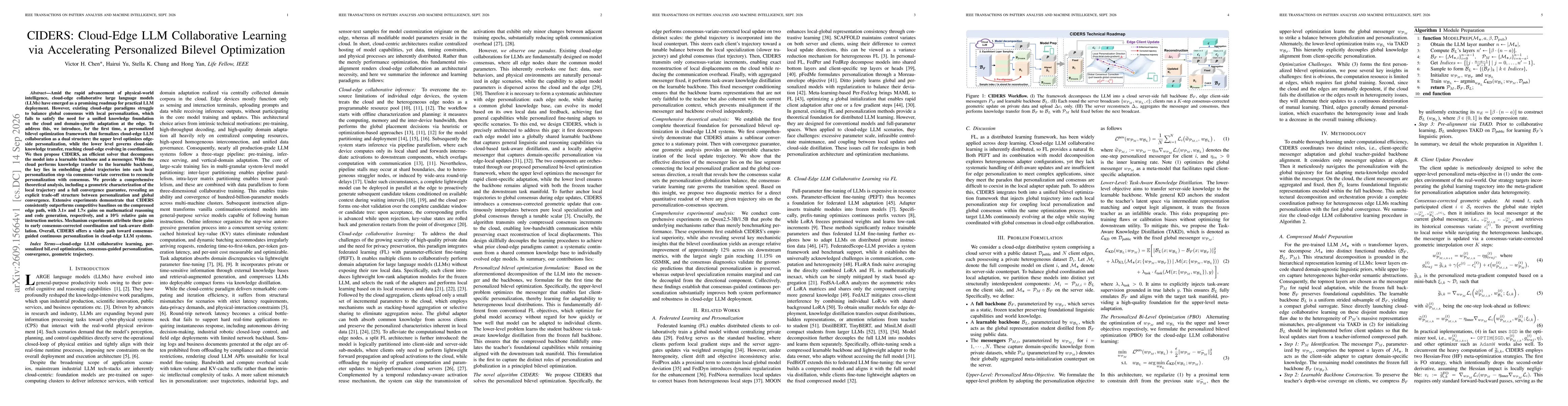
The paper formulates cloud‑edge LLM collaboration as a personalized bilevel optimization problem, with an upper‑level edge personalization step and a lower‑level cloud knowledge‑transfer step, and proposes the CIDERS algorithm that applies consensus‑variate correction to embed global trajectories into each local update.
SignificanceWhy the work matters
The approach balances global consensus with edge personalization, enabling practical deployment of large language models across cloud and edge devices while substantially boosting task performance.
Technical contributionsWhat the work introduces
A novel personalized bilevel optimization framework and the CIDERS algorithm that integrates consensus‑variate correction, together with a geometric analysis of local trajectories and full convergence guarantees.
NoveltyHow it differs from prior work
First work to embed global cloud trajectories into edge personalization via consensus‑variate correction within a bilevel optimization setting for cloud‑edge LLM collaborative learning.
Discussion 0