CLASP: Complementary Layer Selection and Profiling for Zero-Shot OOD Detection using Vision-Language Models
Abstract
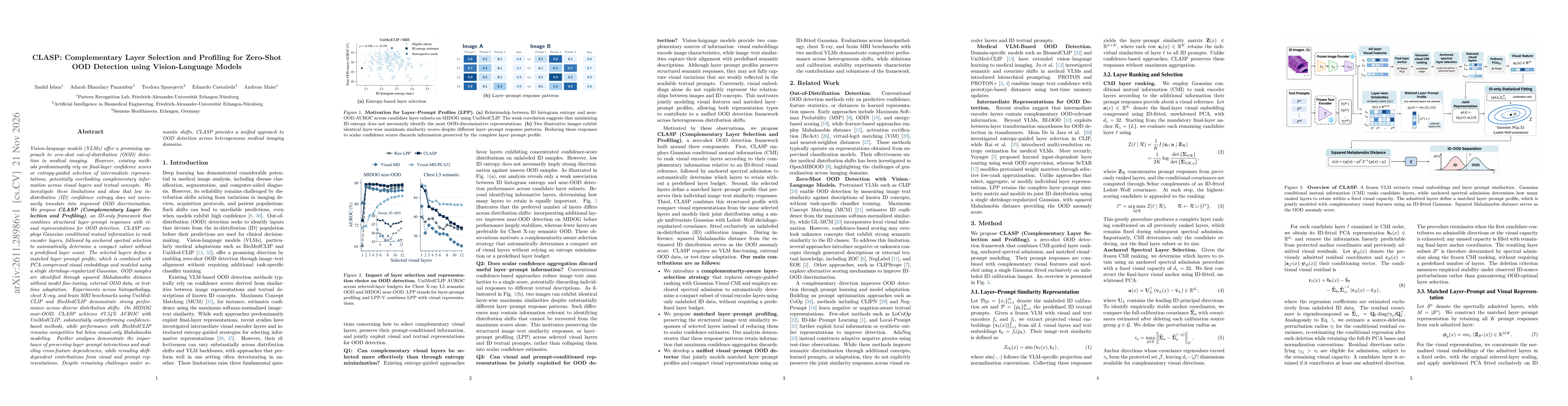
Vision-language models (VLMs) enable zero-shot out-of-distribution (OOD) detection in medical imaging, yet existing approaches often rely on final-layer confidence or entropy-based layer selection, potentially missing complementary information. We show that low in-distribution (ID) confidence entropy does not reliably predict OOD discrimination. We introduce CLASP (Complementary Layer Selection and Profiling), an ID-only framework that jointly models layer--prompt responses and visual features. CLASP ranks visual encoder layers using Gaussian conditional mutual information and selects a compact subset through anchored spectral selection, without fixing the number of layers. It then combines the selected layer--prompt profiles with PCA-compressed visual embeddings and fits a single shrinkage-regularized Gaussian. OOD scores are computed using squared Mahalanobis distance, without fine-tuning, OOD training data, or test-time adaptation. Across histopathology, chest X-ray, and brain MRI benchmarks with UniMedCLIP and BioMedCLIP, CLASP performs strongly under varied distribution shifts. On MIDOG near-OOD, it achieves 87.54% AUROC with UniMedCLIP, outperforming confidence-based baselines; with BioMedCLIP, it remains competitive but trails visual-only Mahalanobis modeling. Ablations highlight the value of layer--prompt interactions and cross-feature dependencies, while exposing shift-dependent contributions and limitations under semantic shifts.
AI Key Findings
Get AI-generated insights about this paper's methodology, results, significance, and more — available when analysis has been generated.
Discussion 0