Cluster-aware Contrastive Learning for Unsupervised Out-of-distribution Detection
The paper proposes a Cluster-aware Contrastive Learning (CCL) framework for unsupervised out-of-distribution detection, enhancing contrastive learning by incorporating both instance-level and semantic-level relationships. The model achieves significant improvements on various image benchmarks by leveraging cluster centers and intra-cluster samples to improve OOD discriminative ability.
Abstract
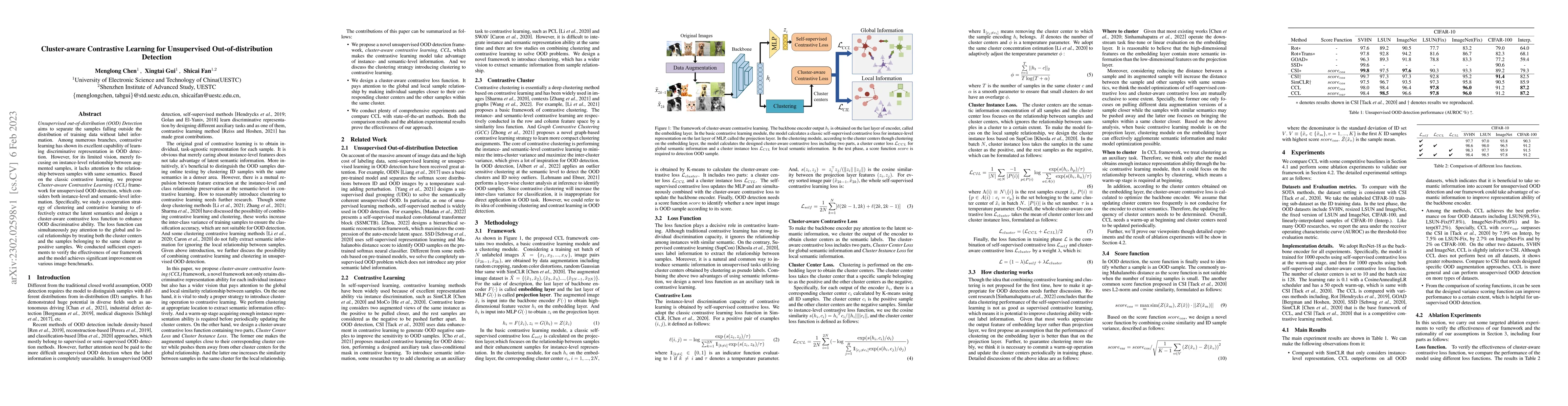
Unsupervised out-of-distribution (OOD) Detection aims to separate the samples falling outside the distribution of training data without label information. Among numerous branches, contrastive learning has shown its excellent capability of learning discriminative representation in OOD detection. However, for its limited vision, merely focusing on instance-level relationship between augmented samples, it lacks attention to the relationship between samples with same semantics. Based on the classic contrastive learning, we propose Cluster-aware Contrastive Learning (CCL) framework for unsupervised OOD detection, which considers both instance-level and semantic-level information. Specifically, we study a cooperation strategy of clustering and contrastive learning to effectively extract the latent semantics and design a cluster-aware contrastive loss function to enhance OOD discriminative ability. The loss function can simultaneously pay attention to the global and local relationships by treating both the cluster centers and the samples belonging to the same cluster as positive samples. We conducted sufficient experiments to verify the effectiveness of our framework and the model achieves significant improvement on various image benchmarks.
AI Key Findings
Get AI-generated insights about this paper's methodology, results, significance, and more — available when analysis has been generated.
Discussion 0