Coarse Indexing, Fine Evidence: Decoupling Temporal Granularity in Long-Video RAG
The paper introduces Density-Aware Graph Construction (DAGC), a training-free method that decouples coarse retrieval indexing from fine-grained evidence in long-video RAG by merging redundant video chunks into a smaller, density-adaptive graph. This keeps about 40–50% of nodes, speeds up end-to-end processing by 1.3–1.7×, and preserves ~99% of QA performance across multiple datasets and backbones, showing that indexing granularity need not match evidence granularity.
Abstract
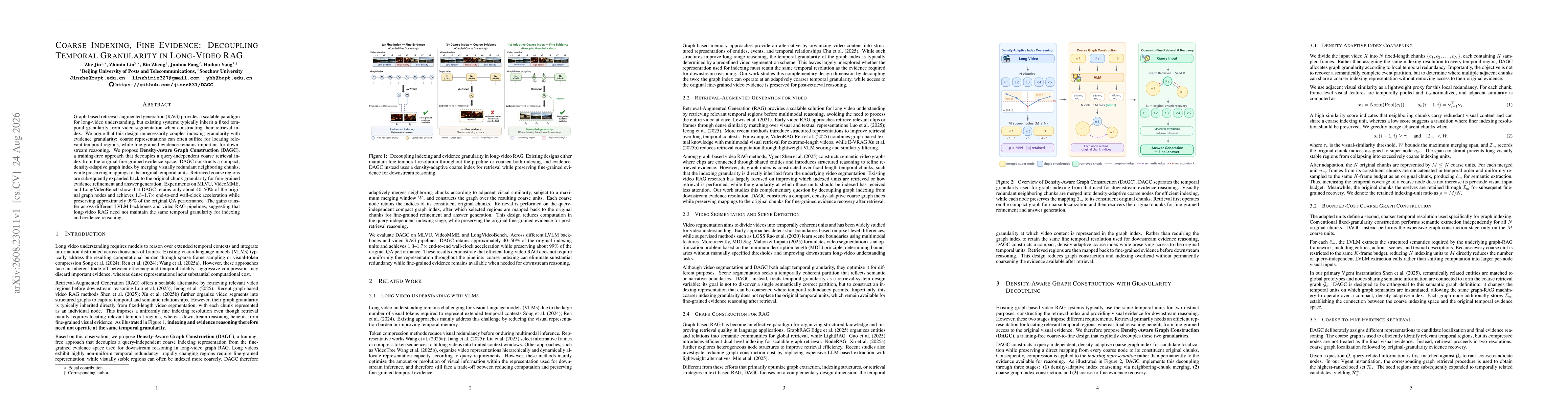
Graph-based retrieval-augmented generation (RAG) provides a scalable paradigm for long-video understanding, but existing systems typically inherit a fixed temporal granularity from video segmentation when constructing their retrieval index. We argue that this design unnecessarily couples indexing granularity with evidence granularity: coarse representations can often suffice for locating relevant temporal regions, while fine-grained evidence remains important for downstream reasoning. We propose \textbf{Density-Aware Graph Construction (DAGC)}, a training-free approach that decouples a query-independent coarse retrieval index from the original fine-grained evidence space. DAGC constructs a compact, density-adaptive graph index by merging visually redundant neighboring chunks, while preserving mappings to the original temporal units. Retrieved coarse regions are subsequently expanded back to the original chunk granularity for fine-grained evidence refinement and answer generation. Experiments on MLVU, VideoMME, and LongVideoBench show that DAGC retains only about 40--50\% of the original graph nodes and achieves $1.3$--$1.7\times$ end-to-end wall-clock acceleration while preserving approximately 99\% of the original QA performance. The gains transfer across different LVLM backbones and video RAG pipelines, suggesting that long-video RAG need not maintain the same temporal granularity for indexing and evidence reasoning.
Analysis
AI-generated · verify against the original paper
Generated Aug 26, 2026ResultsWhat the authors found
- DAGC retains about 40–50% of the original graph nodes yet achieves 1.3–1.7× end-to-end wall-clock acceleration across multiple LVLM backbones and video RAG pipelines while preserving ~99% of original QA performance.
- Across MLVU, VideoMME, and LongVideoBench, the decoupled indexing approach provides consistent efficiency gains without sacrificing downstream reasoning accuracy.
- The gains transfer across different temporal granularities and backbones, indicating robustness of coarse indexing for long-video RAG tasks.
LimitationsWhere the findings need caution
- DAGC uses adjacent visual similarity as a lightweight proxy for redundancy, which may miss semantic changes in visually stable regions (e.g., evolving dialogue or subtle object transitions).
- Effectiveness depends on the degree of index coarsening and may require conservative thresholds in information-dense videos, potentially reducing speedups in such cases.
- The approach is designed for efficient long-video QA rather than precise event segmentation; mappings to complete semantic events are not guaranteed.
MethodologyHow the work was done
DAGC is a training-free approach that decouples a query-independent coarse retrieval index from the fine-grained evidence space by constructing a density-adaptive graph that merges visually redundant neighboring chunks into coarser nodes while preserving mappings to original temporal units. Retrieval is performed on this compact coarse graph, after which retrieved regions are expanded back to original chunks for fine-grained evidence refinement and answer generation. The system includes a density-aware merging mechanism governed by a maximum merging window and similarity threshold to control coarsening, followed by an evidence-recovery process that maps coarse regions back to fine-grained chunks for reasoning.
SignificanceWhy the work matters
The work demonstrates that long-video RAG systems need not rely on a uniformly fine temporal granularity for indexing and evidence reasoning; decoupling indexing granularity from evidence granularity can substantially reduce computation while preserving reasoning quality, enabling scalable long-video understanding.
Technical contributionsWhat the work introduces
Introduction of Density-Aware Graph Construction (DAGC), a training-free method that constructs a density-adaptive, coarse-grained graph index for retrieval while preserving mappings to original fine-grained temporal units for downstream reasoning, enabling significant speedups with minimal QA performance loss.
NoveltyHow it differs from prior work
Decouples indexing granularity from evidence granularity in long-video RAG by dynamically merging neighboring chunks based on visual similarity to form a compact coarse graph, while maintaining a precise mapping back to fine-grained evidence for reasoning—an approach that challenges the conventional coupling of granularity in current video RAG systems.
Future workQuestions that remain
- Explore integration with additional graph structures and retrieval frameworks to broaden evaluation beyond the current LVLM backbones.
- Develop more sophisticated redundancy models that capture semantic changes beyond visual similarity to improve robustness in dynamic scenes.
- Investigate automatic adaptation of merging parameters (τv and W) per video content to optimize the accuracy-efficiency trade-off further.
Discussion 0