CoCoFL_Continual_Computing_for_Federated_Learning_over_Intermittent_Satellite-Ground_Links
Abstract
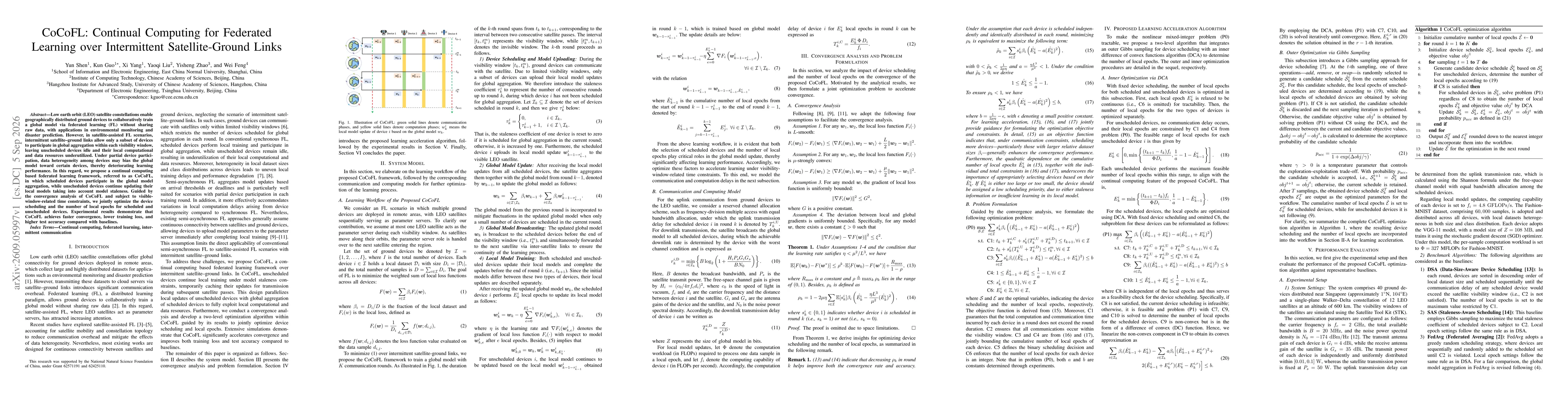
Low earth orbit (LEO) satellite constellations enable geographically distributed ground devices to collaboratively train a global model via federated learning (FL) without sharing raw data, with applications in environmental monitoring and disaster prediction. However, in satellite-assisted FL scenarios, intermittent satellite-ground links allow only a subset of devices to participate in global aggregation within each visibility window, leaving unscheduled devices idle and their local computational and data resources underutilized. Under partial device participation, data heterogeneity among devices may bias the global model toward certain devices, thereby deteriorating learning performance. In this regard, we propose a continual computing based federated learning framework, referred to as CoCoFL, in which scheduled devices participate in the global model aggregation, while unscheduled devices continue updating their local models taking into account model staleness. Guided by the convergence analysis of CoCoFL and subject to visible-window-related time constraints, we jointly optimize the device scheduling and the number of local epochs for scheduled and unscheduled devices. Experimental results demonstrate that CoCoFL achieves faster convergence, lower training loss, and higher test accuracy compared with baselines.
AI Key Findings
Get AI-generated insights about this paper's methodology, results, significance, and more — available when analysis has been generated.
Discussion 0