Coexisting Regular and Chaotic Dynamics in the Dysprosium Feshbach Spectrum
Abstract
Strongly dipolar gases, such as dysprosium, erbium and thulium, exhibit dense Feshbach spectra whose level statistics have been associated with quantum chaos arising from couplings among many molecular channels. Here, we combine a precise calibration of the Feshbach spectrum of $^{162}$Dy with spectroscopic measurements of the differential magnetic moments of bound states associated with more than 80 resonances between 0 and 30 G. These magnetic moments provide an eigenstate-sensitive probe of the molecular states underlying the resonance spectrum. We find that the level statistics are not uniform: resonances associated with states near the center of the magnetic-moment distribution display enhanced level repulsion, whereas those near the lower edge remain close to Poisson statistics. Our results reveal hidden structure within the chaotic dysprosium Feshbach spectrum and identify molecular-state composition as a key ingredient in the emergence of quantum chaos in strongly dipolar scattering.
Analysis
AI-generated · verify against the original paper
Generated Jun 30, 2026ResultsWhat the authors found
- Resonances near the center of the δμ distribution exhibit enhanced level repulsion (β ~ 0.6) indicating chaotic-like statistics, while those at the lower edge remain close to Poisson (β ~ 0).
- A hidden structure is revealed within an overall chaotic-like spectrum when resonances are grouped by their associated molecular states through δμ, implying molecular-state composition governs chaos emergence.
- Two complementary diagnostics—β from P(s) and ⟨r⟩ from consecutive spacings—show consistent but non-redundant information about short-range spectral statistics across δμc windows.
LimitationsWhere the findings need caution
- Analysis relies on finite resonance counts (128 resonances with δμ determined for 83), which may limit fine-grained resolution of edge vs center statistics.
- Unfolding procedure and windowing choices introduce some dependence on methodological parameters, though robustness checks were performed.
- Spectral statistics are short-range; global statistics may obscure additional structure beyond the δμ-resolved view.
MethodologyHow the work was done
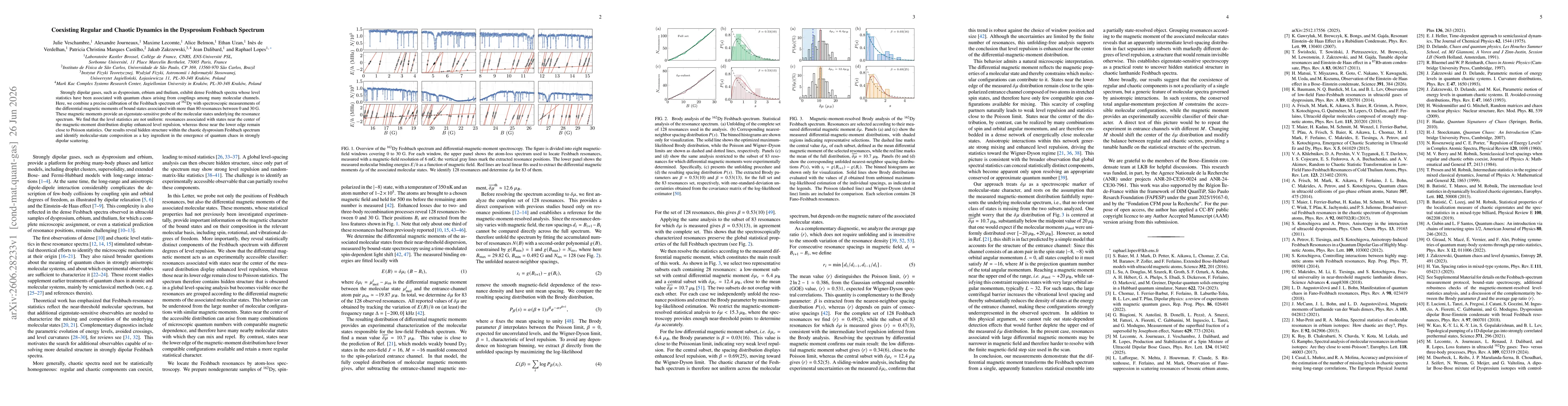
The study combines precise calibration of the 162Dy Feshbach spectrum with bound-state spectroscopy to measure differential magnetic moments δμ of bound states linked to over 80 resonances between 0 and 30 G. Resonances are identified via atom-loss spectroscopy, with local energy E(B) fits E(B)=δμi(B−Bi) to extract δμi, yielding a distribution centered around δμ ≈ 10.7 μB. The spectrum is unfolded with a second-order polynomial fit to remove density variation, and short-range spectral statistics are analyzed via the Brody parameter β from the unfolded nearest-neighbor spacings and the average gap ratio ⟨r⟩; a sliding-window approach over δμc is used to reveal structure across the distribution.
SignificanceWhy the work matters
The work demonstrates that quantum chaos in strongly dipolar molecular spectra is not uniform; molecular-state composition, accessible via differential magnetic moments, partially resolves the spectrum into components with distinct level-repulsion, highlighting the role of internal structure in chaotic scattering and advancing the understanding of how regular and chaotic dynamics coexist in complex quantum systems.
Technical contributionsWhat the work introduces
Demonstrates a novel experimental protocol to resolve Feshbach resonance spectra by measuring differential magnetic moments of bound states, enabling state-resolved spectral statistics and unveiling hidden structure in a densely chaotic spectrum.
NoveltyHow it differs from prior work
Introduces an experimentally accessible observable—the differential magnetic moment δμ—as a classifier for resonance states, revealing that coexisting regular and chaotic dynamics in a strongly dipolar Feshbach spectrum depend on molecular-state composition rather than solely on global level statistics.
Future workQuestions that remain
- Extend δμ-resolved spectroscopy to other dysprosium isotopes or lanthanides to test generality of the observed coexisting regular and chaotic dynamics.
- Develop a microscopic model connecting specific molecular configurations to δμ and their mixing to predict β(δμc) from first principles.
- Explore time-dependent or driven dynamics to study how the identified structured chaos influences many-body behavior and lattice-model mappings with long-range interactions.
Discussion 0