Combined magnetic and structural transition state in first-principles calculations
Abstract
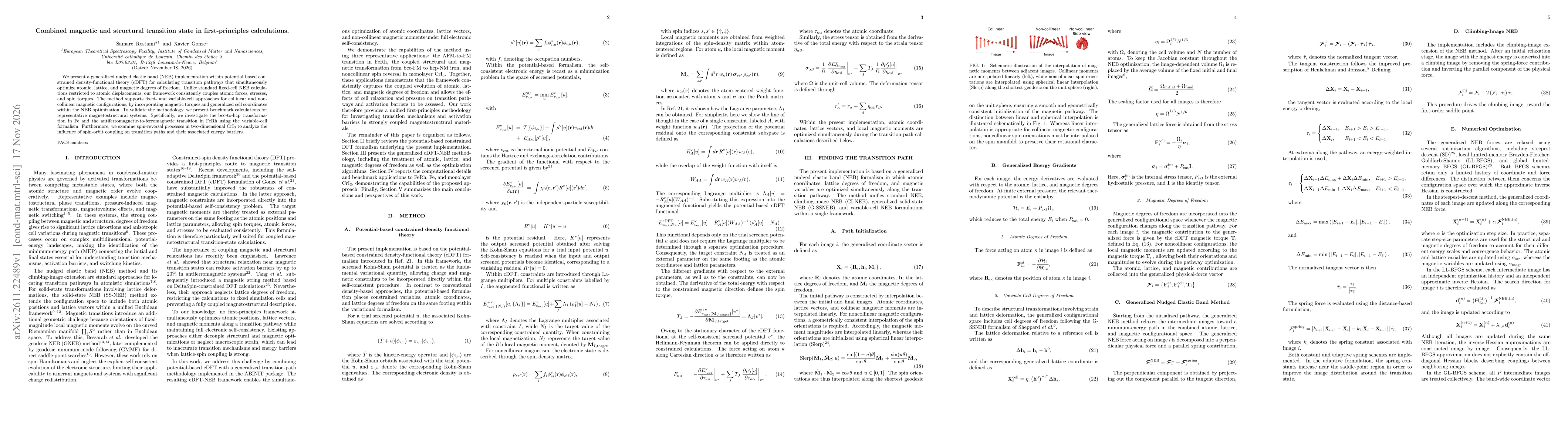
We present a generalized nudged elastic band (NEB) implementation within potential-based constrained density-functional theory (cDFT) for calculating transition pathways that simultaneously optimize atomic, lattice, and magnetic degrees of freedom. Unlike standard fixed-cell NEB calculations restricted to atomic displacements, our framework consistently couples atomic forces, stresses, and spin torques. The method supports fixed- and variable-cell approaches for collinear and non- collinear magnetic configurations, by incorporating magnetic torques and generalized cell coordinates within the NEB optimization. To validate the methodology, we present benchmark calculations for representative magnetostructural systems. Specifically, we investigate the bcc-to-hcp transformation in Fe and the antiferromagnetic-to-ferromagnetic transition in FeRh using the variable-cell formalism. Furthermore, we examine spin-reversal processes in two-dimensional CrI3 to analyze the influence of spin-orbit coupling on transition paths and their associated energy barriers.
Analysis
AI-generated · verify against the original paper
Generated Jan 1, 0001ResultsWhat the authors found
- Variable‑cell cDFT‑NEB calculations for FeRh show activation barriers similar to fixed‑cell results, indicating a modest effect of cell relaxation.
- The bcc‑to‑hcp transformation in Fe captures simultaneous lattice deformation, atomic shuffling, volume reduction, and collapse of magnetic moments, demonstrating strong magnetostructural coupling.
- Spin‑reversal in monolayer CrI3 yields a magnetic anisotropy barrier of ~0.2 meV/atom with negligible atomic and lattice relaxations, illustrating the method’s ability to treat predominantly magnetic transitions.
MethodologyHow the work was done
A generalized nudged elastic band (NEB) implementation within potential-based constrained density-functional theory (cDFT) that simultaneously optimizes atomic positions, lattice vectors, and non‑collinear magnetic moments by consistently coupling atomic forces, stresses, and spin torques, supporting both fixed‑ and variable‑cell calculations for collinear and non‑collinear magnetic configurations.
SignificanceWhy the work matters
The framework provides a unified first‑principles platform for investigating transition mechanisms and activation barriers in strongly coupled magnetostructural materials, enabling accurate description of both structural and magnetic contributions to reaction pathways.
Technical contributionsWhat the work introduces
Integration of potential‑based constrained DFT with a generalized NEB algorithm, incorporating magnetic torques and generalized cell coordinates to allow fully self‑consistent optimization of atomic, lattice, and magnetic degrees of freedom within the ABINIT package.
NoveltyHow it differs from prior work
First first‑principles framework that simultaneously optimizes atomic positions, lattice vectors, and magnetic moments along a transition path while maintaining full electronic self‑consistency, surpassing previous methods that decouple structural and magnetic optimizations or neglect cell degrees of freedom.
Future workQuestions that remain
- Application of the cDFT‑NEB approach to pressure‑induced magnetic transitions and magnetovolume transformations.
- Extension to a broader class of non‑collinear magnetic materials and complex energy landscapes.
- Investigation of computational efficiency and scalability for larger systems.
Discussion 0