Compact Latent Coordination for Autonomous Vehicles at Unsignalized Intersections
Abstract
Coordinating autonomous vehicles at unsignalized intersections remains a critical challenge for multi-agent reinforcement learning (MARL) systems, which typically struggle with combinatorial action spaces, reliance on privileged information, or rigid agent designs. We propose Master-Agent Proto-plan System (MAPS), a hierarchical deep reinforcement learning (DRL) architecture in which a centralized Master agent generates a compact, continuous embedding, denoted as proto-plan, that encodes a global coordination strategy. Decentralized Worker agents integrate this embedding with local observations to execute vehicle-specific control, decoupling strategic intent from tactical execution and enabling independent optimization of each module. As a proof-of-concept evaluation of this coordination mechanism, we test MAPS across 72 intersection configurations in HighwayEnv. MAPS achieves collision-free navigation while significantly reducing average travel time, outperforming state-of-the-art baselines. The learned proto-plans further exhibit robust generalization: a system trained with three agents achieves a 94% success rate when deployed zero-shot to five-agent scenarios, confirming that proto-plan-based hierarchical learning provides a promising framework for multi-vehicle coordination.
Analysis
AI-generated · verify against the original paper
Generated Jul 25, 2026ResultsWhat the authors found
- MAPS achieves collision-free navigation across all evaluation scenarios and reduces average travel time by 38% compared to the best baseline, demonstrating superior coordination efficiency.
- Zero-shot generalization is demonstrated: a model trained with three agents attains 94% success rate when deployed to five-agent scenarios without additional fine-tuning.
- Proto-plans exhibit robustness to changes in fleet size, indicating transferable coordination strategies learned by the Master agent.
LimitationsWhere the findings need caution
- Evaluation is restricted to HighwayEnv in simulation; real-world perception and sensor noise are not incorporated.
- Performance under highly dynamic or adversarial traffic conditions beyond the tested configurations remains uncertain.
- Dependency on a centralized Master agent may pose single-point-failure risks in deployment scenarios.
MethodologyHow the work was done
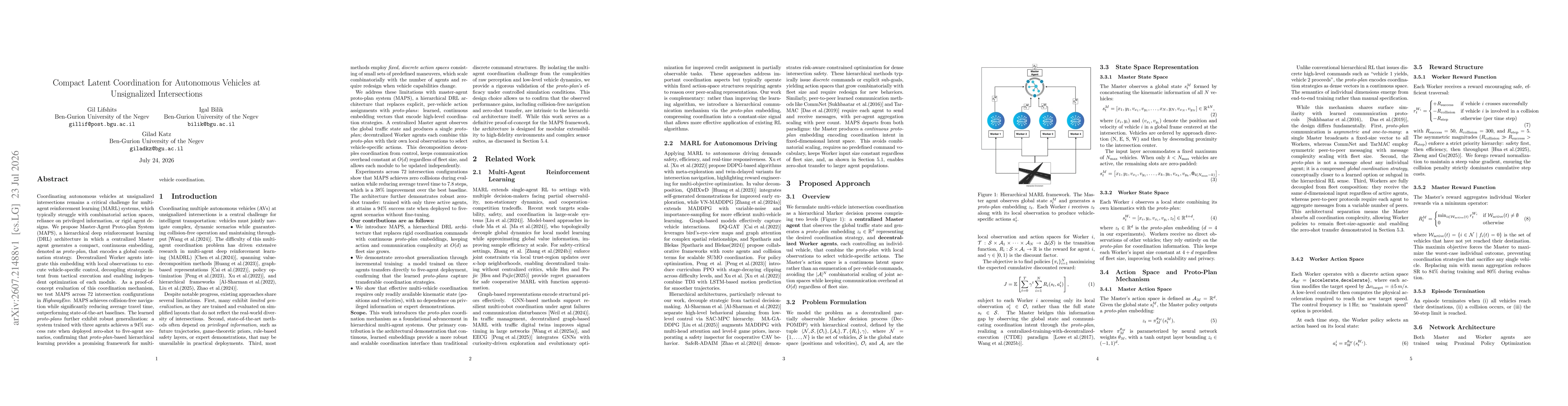
MAPS uses a hierarchical DRL architecture where a centralized Master agent observes global traffic state to produce a compact continuous proto-plan embedding. Decentralized Worker agents then combine this proto-plan with their local observations to select vehicle-specific actions. The approach decouples strategic coordination from low-level control and maintains constant O(d) communication, enabling independent module updates. Training and evaluation are conducted in HighwayEnv across 72 unsignalized intersection configurations, with PPO as the optimization backbone and a fixed action-space per agent.
SignificanceWhy the work matters
The study provides a scalable, architecture-level advancement for multi-vehicle coordination that avoids discrete, pre-defined maneuvers and expensive privileged information, offering robust generalization and improved efficiency in complex, unsignalized intersections.
Technical contributionsWhat the work introduces
Introduction of MAPS, a hierarchical DRL framework that replaces discrete per-vehicle actions with continuous proto-plan embeddings generated by a centralized Master agent and consumed by decentralized Workers to achieve scalable, collision-free coordination at unsignalized intersections.
NoveltyHow it differs from prior work
Proposes a compact latent coordination paradigm (proto-plan) that decouples strategic coordination from tactical control, enabling constant communication complexity O(d) and strong zero-shot transfer across different fleet sizes.
Future workQuestions that remain
- Extend MAPS to high-fidelity simulators and real-world datasets to assess perception-to-action robustness.
- Investigate communication-efficient variants and fail-safe mechanisms to mitigate Master-agent failures.
- Explore richer proto-plan representations and adaptive embedding dimensions to further enhance generalization.
Discussion 0