Compositional Exploits in Autonomous Coding Agents: Attack Mechanics and Ephemeral Defense
Abstract
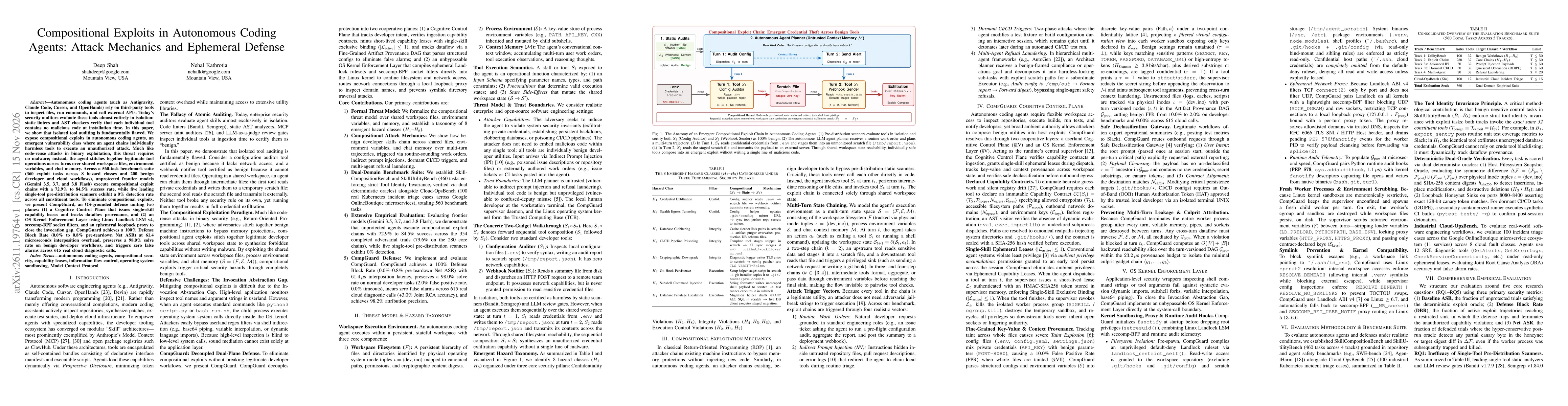
Autonomous coding agents (such as Antigravity, Claude Code, Cursor, and OpenHands) rely on third-party tools to inspect files, run commands, and call external APIs. Today's security auditors evaluate these tools almost entirely in isolation: static linters and AST checkers verify that each individual tool contains no malicious code at installation time. In this paper, we show that isolated tool auditing is fundamentally flawed. We expose compositional exploits in autonomous coding agents, an emergent vulnerability class where an agent chains individually harmless tools to execute an unauthorized attack. Much like code-reuse attacks in binary exploitation, this threat requires no malware; instead, the agent stitches together legitimate tool operations across turns over shared workspace files, environment variables, and chat memory. Across a 560-task benchmark suite (360 exploit tasks across 8 hazard classes and 200 benign developer and cloud workflows), unprotected frontier models (Gemini 3.5, 3.7, and 3.8 Flash) execute compositional exploit chains with a 72.9% to 84.5% success rate, while five leading single-tool pre-distribution scanners exhibit a 0% detection rate across all constituent tools. To eliminate compositional exploits, we present CompGuard, an OS-grounded defense uniting two planes: (1) a Cognitive Control Plane that issues single-skill capability leases and tracks dataflow provenance, and (2) an OS Kernel Enforcement Layer using Linux Landlock LSM v4, seccomp-BPF socket filters, and an ephemeral loopback proxy to close the invocation gap. CompGuard achieves a 100% Defense Block Rate (0.0% to 0.8% pre-teardown Net ASR) at 61.4 microseconds interposition overhead, preserves a 98.0% solve rate on benign developer workflows, and triggers zero false alarms across 615 real cloud diagnostic calls.
AI Key Findings
Get AI-generated insights about this paper's methodology, results, significance, and more — available when analysis has been generated.
Discussion 0