Computing higher direct images in Macaulay2
The ToricHigherDirectImages package in Macaulay2 is introduced, featuring a method to compute higher direct images of line bundles via surjective toric morphisms, aiding in complex algebraic geometry computations.
Abstract
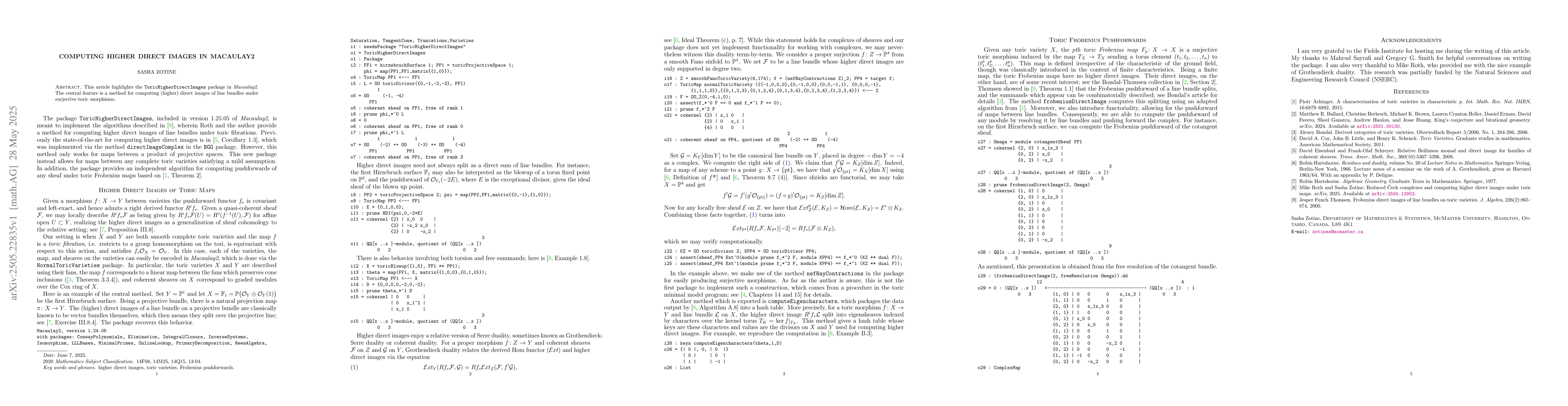
This article highlights the ToricHigherDirectImages package in Macaulay2. The central feature is a method for computing (higher) direct images of line bundles under surjective toric morphisms.
Analysis
AI-generated · verify against the original paper
Generated Jun 6, 2025ResultsWhat the authors found
- Introduces an efficient method for computing higher direct images in toric varieties.
- Demonstrates the implementation and effectiveness of the method through examples and case studies.
LimitationsWhere the findings need caution
- The method is currently limited to surjective toric morphisms.
- Computational complexity might be a concern for very large or complex toric varieties.
MethodologyHow the work was done
The research employs the ToricHigherDirectImages package in Macaulay2 to develop a method for computing higher direct images of line bundles under surjective toric morphisms.
SignificanceWhy the work matters
This research is important as it provides a practical tool for algebraic geometers working with toric varieties, facilitating computations of higher direct images which are crucial in understanding morphisms between such varieties.
Technical contributionsWhat the work introduces
The primary technical contribution is the development of an algorithm and its implementation in Macaulay2 for computing higher direct images of line bundles under surjective toric morphisms.
NoveltyHow it differs from prior work
This work introduces a novel approach specifically tailored for toric geometry, filling a gap in computational tools for higher direct image computations in this context.
Future workQuestions that remain
- Explore extending the method to non-toric varieties or more general morphisms.
- Investigate optimizations to handle larger and more complex computations efficiently.
Discussion 0