Confinement effects on protein stability in a freezing water environment
Using molecular dynamics with explicit ice formation, the study shows that freezing water constrains yeast frataxin's motions: as ice crystallizes, the protein’s conformational space becomes discretized and confined, even though the first hydration layer remains liquid-like. The surrounding water’s structure—not just temperature—drives protein stability by densifying interfacial hydration and limiting sampling, highlighting water organization as a key determinant of protein behavior in freezing environments.
Abstract
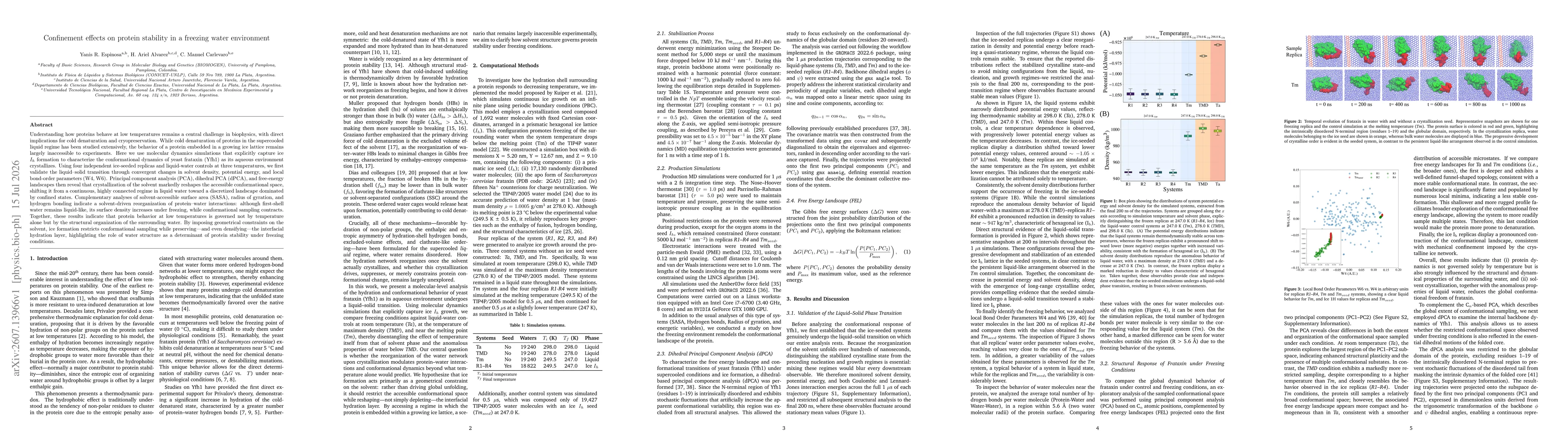
Understanding how proteins behave at low temperatures remains a central challenge in biophysics, with direct implications for cold denaturation and cryopreservation. While cold denaturation of proteins in the supercooled liquid regime has been studied extensively, the behavior of a protein embedded in a growing ice lattice remains largely inaccessible to experiments. Here we use molecular dynamics simulations that explicitly capture ice Ih formation to characterize the conformational dynamics of yeast frataxin (Yfh1) as its aqueous environment crystallizes. Using four independent ice-seeded replicas and liquid-water controls at three temperatures, we first validate the liquid-solid transition through convergent changes in solvent density, potential energy, and local bond-order parameters (W4, W6). Principal component analysis (PCA), dihedral PCA (dPCA), and free-energy landscapes then reveal that crystallization of the solvent markedly reshapes the accessible conformational space, shifting it from a continuous, highly connected regime in liquid water toward a discretized landscape dominated by confined states. Complementary analyses of solvent-accessible surface area (SASA), radius of gyration, and hydrogen bonding indicate a solvent-driven reorganization of protein-water interactions: although first-shell water remains liquid-like, its surface density increases under freezing, while conformational sampling contracts. Together, these results indicate that protein behavior at low temperatures is governed not by temperature alone but by the structural organization of the surrounding water. By imposing geometrical constraints on the solvent, ice formation restricts conformational sampling while preserving -- and even densifying -- the interfacial hydration layer, highlighting the role of water structure as a determinant of protein stability under freezing conditions.
Analysis
AI-generated · verify against the original paper
Generated Jul 17, 2026ResultsWhat the authors found
- Crystallization of the solvent restructures conformational space, shifting from a continuous, highly connected liquid-state landscape to a discretized space dominated by confined states.
- Although first-shell water remains liquid-like, its surface density increases under freezing, indicating reinforced interfacial hydration while sampling contracts.
- Solvent-driven reorganization of protein-water interactions accompanies freezing, with constrained conformational sampling yet preserved interfacial hydration layer.
LimitationsWhere the findings need caution
- Study relies on a single protein model (Yfh1) and a specific ice seed geometry, limiting generality across proteins and ice morphologies.
- Simulations use a fixed ice Ih seed and finite system sizes, which may influence crystallization dynamics and hydration layering compared to bulk freezing.
- Timescales (~1 µs per replica) may be insufficient to capture slower unfolding events or alternative hydration rearrangements under extreme freezing.
MethodologyHow the work was done
Molecular dynamics simulations of Yfh1 embedded in ice Ih formed around a prismatic ice seed, using four independent ice-seeded replicas and liquid-water controls at Ta, TMD, and Tm. TIP4P/2005 water model was used with a predefined Ic seed to promote ice growth; systems included protein, water, and counterions, with analyses including solvent density, potential energy, local bond-order parameters, PCA/dPCA, free-energy landscapes, SASA, radius of gyration, and hydrogen bonding.
SignificanceWhy the work matters
Demonstrates that water structure and phase state, not temperature alone, govern protein stability under freezing by geometrically constraining solvent and modulating interfacial hydration, with implications for cryopreservation and cold-denaturation mechanisms.
Technical contributionsWhat the work introduces
Integration of explicit ice Ih growth around a protein in MD simulations with multi-replica analysis, coupled with advanced conformational space analyses (PCA, dPCA, free-energy landscapes) and hydration metrics (SASA, hydration density, persistent waters) to link water structure to protein dynamics under freezing.
NoveltyHow it differs from prior work
First explicit molecular-level demonstration that ice formation imposes geometric constraints on solvent that reshape protein conformational landscapes and tighten interfacial hydration, offering a mechanistic link between water structure during freezing and protein stability.
Future workQuestions that remain
- Investigate other proteins with varying surface properties to assess generality of solvent-structure gating on conformational dynamics during ice formation.
- Explore different ice crystallization seeds and ice polymorphs to determine sensitivity of hydration and conformational constraints to ice geometry.
- Extend simulations to longer timescales and include enhanced sampling to observe potential rare events and full denaturation pathways under freezing.
Discussion 0