Constraints on R-parity Violation from Precision Electroweak Measurements
Summary: This paper investigates the limits on R-parity violating interactions by analyzing precision electroweak measurements, providing constraints on the associated coupling constants. The findings contribute to the understanding of potential new physics beyond the Standard Model.
Analysis
AI-generated · verify against the original paper
Generated Sep 3, 2025ResultsWhat the authors found
- Constraints on R-parity violating couplings λ′i3k and λ′′3jk from hadronic observables at LEP and SLD.
- Lepton universality breaking shifts constrained by leptonic data from LEP and SLD.
LimitationsWhere the findings need caution
- The analysis assumes only one of λ′i3k or λ′′3jk terms is present at a time due to fast proton decay concerns.
- The constraints are based on a common sfermion mass of 100 GeV; different masses would require rescaling the limits.
MethodologyHow the work was done
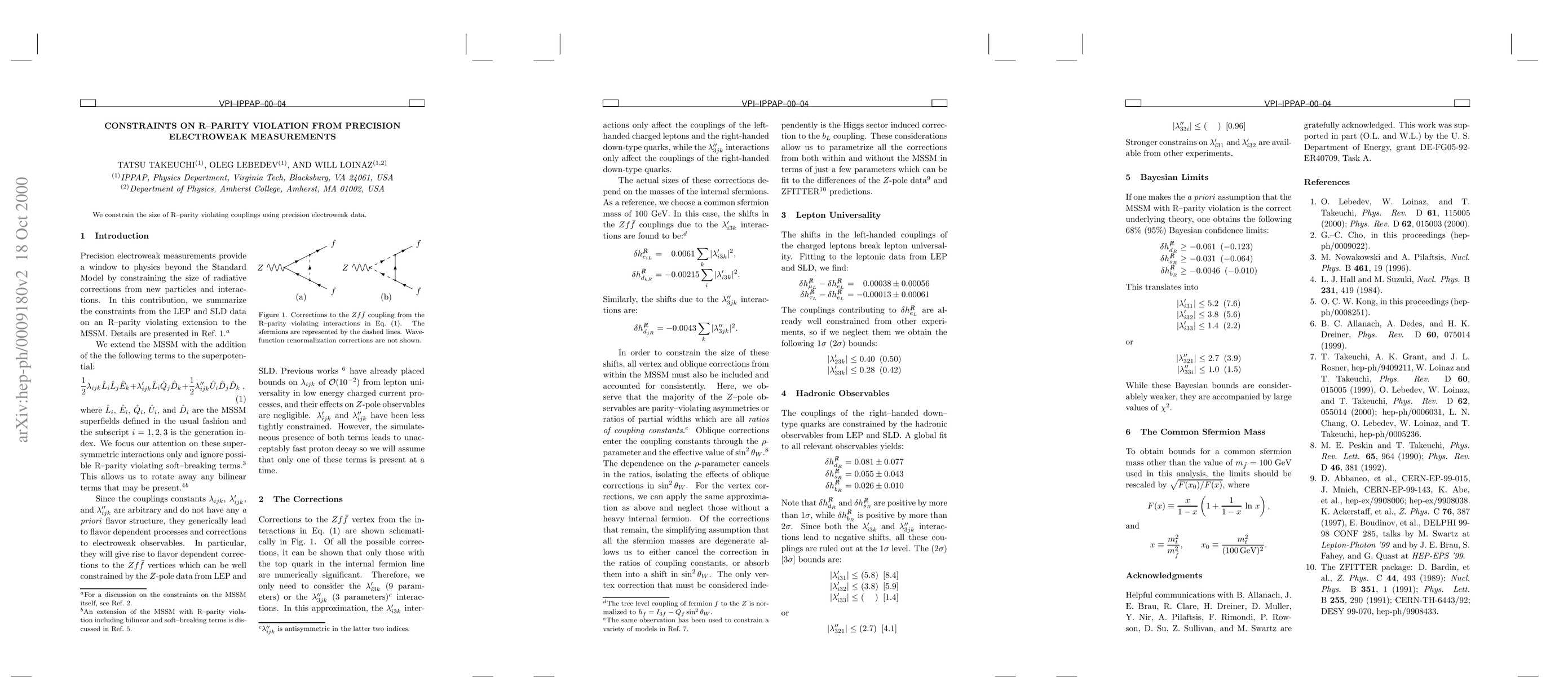
The research constrains R-parity violating couplings using precision electroweak data from LEP and SLD, focusing on super-symmetric interactions and ignoring soft-breaking terms. It analyzes corrections to Zff vertices caused by R-parity violating interactions, considering only those involving the top quark in the internal fermion line due to their numerical significance.
SignificanceWhy the work matters
This study is important as it provides constraints on R-parity violating extensions of the MSSM using precision electroweak measurements, contributing to our understanding of physics beyond the Standard Model.
Technical contributionsWhat the work introduces
The paper presents a detailed analysis of R-parity violating corrections to Zff vertices and their impact on electroweak observables, providing a comprehensive study of constraints from precision electroweak measurements.
NoveltyHow it differs from prior work
This work extends previous studies by focusing on numerical significance of specific R-parity violating interactions and their impact on electroweak observables, offering a more targeted analysis of constraints.
Future workQuestions that remain
- Further investigation into the impact of other sfermion mass values on constraints.
- Exploration of additional experimental data sources for more stringent constraints.
Discussion 0