Continuous superradiant lasing on a narrow optical transition
Abstract
Lasers with ultrastable frequency are at the foundation of optical clocks, which enable precision tests of fundamental physics and relativistic geodesy at the centimetre scale. Such lasers inherit their frequency stability from the length stability of a sophisticated optical resonator, which is hard to maintain outside a well-controlled laboratory environment and limited by thermal and technical noise. Superradiant lasers promise to overcome these limitations by storing their coherence in the atoms making up the laser's gain medium. Superradiant lasing has been demonstrated on narrow optical atomic transitions with pulsed and quasi-continuous operation. However, atom loss has prevented truly continuous operation, which severely limits their suitability for clocks. Here we demonstrate a superradiant laser on a narrow optical transition in $^{88}$Sr that operates truly continuously. We sustain emission for more than eight hours and measure a linewidth of 320(40) Hz, more than 20 times below the natural linewidth. The emission frequency remains anchored to the atomic transition, making the laser itself an atomic frequency reference. Our results provide a route towards a laser that reaches short-term frequency stability comparable to that of the best resonator-stabilized lasers. Furthermore, truly continuous operation gives us access to physics beyond the transient regime, enabling the exploration of robust nonequilibrium steady states and sustained coherent collective dynamics.
Analysis
AI-generated · verify against the original paper
Generated Jan 1, 0001ResultsWhat the authors found
- Continuous superradiant lasing was sustained for more than eight hours without interruption.
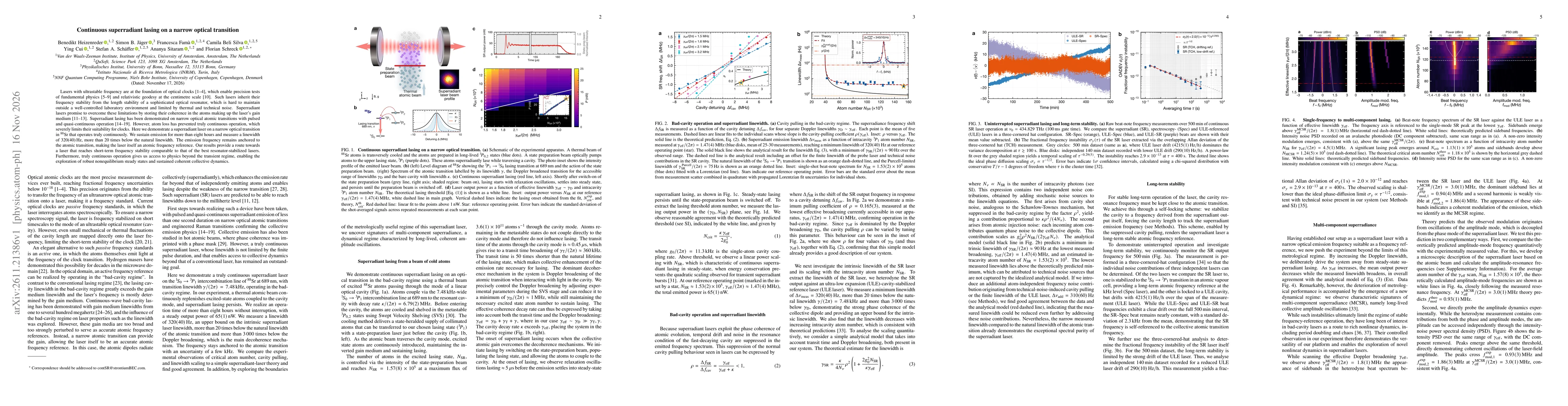
- The measured laser linewidth is 320 ± 40 Hz, more than 20 times narrower than the natural 7.48 kHz transition linewidth.
- Steady‑state output power of 65 nW was achieved with an effective atom number N_SR ≈ 1.6 × 10^5.
- The emission frequency remains anchored to the atomic transition with an uncertainty of only a few kHz.
LimitationsWhere the findings need caution
- The dominant decoherence mechanism is Doppler broadening, limiting the effective coherence decay rate.
- Transit‑time broadening (~360 kHz) contributes to the effective linewidth and must be managed.
MethodologyHow the work was done
A thermal beam of 88Sr atoms is transversely cooled and optically pumped into the 3P1 lasing state just before entering a high‑finesse optical cavity operating in the bad‑cavity regime. Continuous replenishment of excited‑state atoms via a state‑preparation laser maintains the inverted gain medium, enabling steady‑state superradiant emission on the 1S0→3P1 intercombination line.
SignificanceWhy the work matters
The work demonstrates a truly continuous superradiant laser that can serve as an atomic frequency reference, offering short‑term stability comparable to the best resonator‑stabilized lasers and opening access to robust nonequilibrium steady states and sustained collective dynamics.
Technical contributionsWhat the work introduces
First demonstration of a truly continuous superradiant laser on a narrow optical transition in 88Sr, achieving >8 h operation and sub‑natural‑linewidth emission, thereby overcoming previous atom‑loss limitations.
NoveltyHow it differs from prior work
The experiment realizes continuous, rather than pulsed or quasi‑continuous, superradiant lasing on a narrow atomic transition, delivering a linewidth 20× below the natural linewidth and establishing a new platform for active optical frequency references.
Future workQuestions that remain
- Further reduction of Doppler and transit‑time broadening to approach the millihertz‑level linewidth predicted for superradiant lasers.
- Exploration of the robust nonequilibrium steady states and multi‑component superradiance dynamics enabled by continuous operation.
- Integration of the continuous superradiant source into optical‑clock architectures to assess long‑term frequency stability.
Discussion 0