Contract-Based Decomposition of Temporal Logic Specifications for Networked Systems under Arbitrary Partitions
Abstract
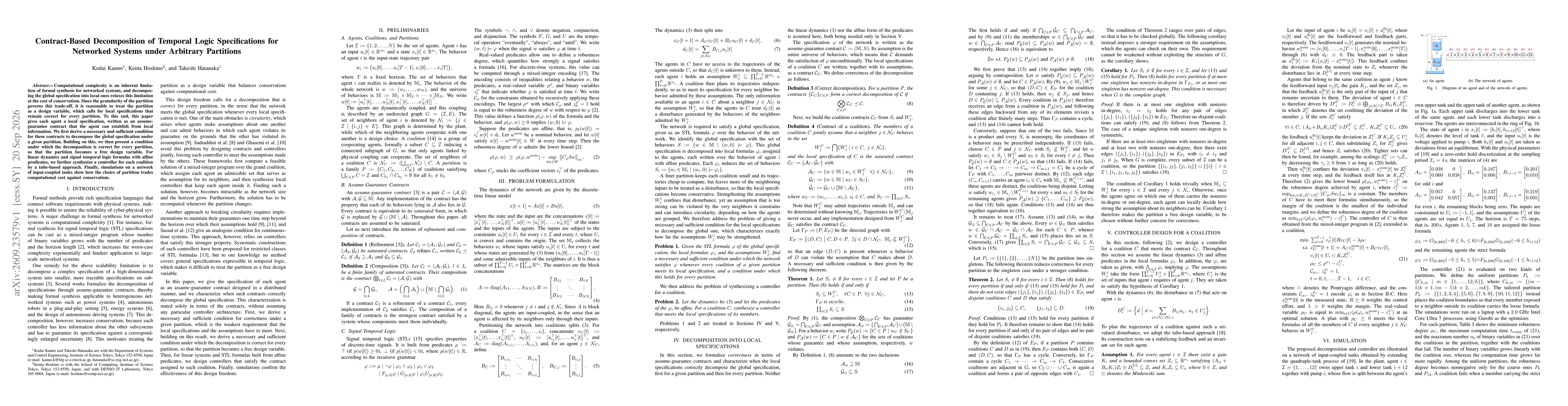
Computational complexity is an inherent limitation of formal synthesis for networked systems, and decomposing the global specification into local ones relaxes this limitation at the cost of conservatism. Since the granularity of the partition governs this trade-off, it is reasonable to treat the partition as a design variable, which calls for local specifications that remain correct for every partition. To this end, this paper gives each agent a local specification, written as an assume-guarantee contract that the agent can establish from local information. We first derive a necessary and sufficient condition for these contracts to decompose the global specification under a given partition. Building on this, we then present a condition under which the decomposition is correct for every partition, so that the partition becomes a free design variable. For linear dynamics and signal temporal logic formulas with affine predicates, we further synthesize a controller for each coalition by a tube-based approach. Finally, simulations on a network of input-coupled tanks show how the choice of partition trades computational cost against conservatism.
Analysis
AI-generated · verify against the original paper
Generated Jan 1, 0001ResultsWhat the authors found
- A necessary and sufficient condition for contract‑based decomposition of the global specification under a specific partition is established.
- A second condition ensures that the decomposition remains correct for every possible partition, making the partition a free design variable.
- A tube‑based synthesis method produces local controllers that satisfy the derived contracts for linear systems with affine STL formulas.
- Simulations demonstrate that coarser partitions reduce computational time and binary variable count but increase conservatism, while tailored partitions achieve a favorable trade‑off.
- The approach successfully maintains non‑negative robustness degrees for selected partitions, confirming the practical effectiveness of the method.
LimitationsWhere the findings need caution
- The theoretical results and controller synthesis are limited to linear dynamics and STL formulas with affine predicates.
- Conservatism may increase for fine partitions, potentially leading to infeasibility of the local contracts.
- Scalability is still constrained by the growth of binary variables in the mixed‑integer programs as coalition size increases.
MethodologyHow the work was done
The paper derives necessary and sufficient conditions for assume‑guarantee contracts to correctly decompose a global STL specification under a given partition, then extends this to a condition that guarantees correctness for any partition. For linear dynamics with affine STL predicates, a tube‑based controller is synthesized for each coalition, and the approach is validated via simulations on a network of input‑coupled tanks.
SignificanceWhy the work matters
By treating the network partition as a design variable and providing guarantees that hold for any partition, the work substantially reduces the computational burden of formal synthesis for large‑scale networked systems while preserving correctness of the overall temporal‑logic specification.
Technical contributionsWhat the work introduces
The paper provides (i) a necessary and sufficient condition for correct contract‑based decomposition of global STL specifications, (ii) a partition‑independent condition enabling the partition to be a free design variable, (iii) a tube‑based controller synthesis for each coalition under linear dynamics, and (iv) empirical validation on a multi‑tank network illustrating the trade‑off between computational cost and conservatism.
NoveltyHow it differs from prior work
It is the first work to guarantee correctness of assume‑guarantee contract decomposition for any arbitrary partition, thereby allowing the partition to be freely chosen as a design parameter while still ensuring global specification satisfaction.
Future workQuestions that remain
- Develop adaptive algorithms that dynamically form coalitions based on system states and specifications.
- Extend the framework to handle nonlinear dynamics and more general temporal‑logic specifications.
- Investigate mechanisms to resolve deadlocks arising from limited access to other agents' behaviors.
Discussion 0