Contract2Reach: Discretization-Induced Contractive Dynamic Programming for High-Dimensional Hamilton-Jacobi Reachability
Abstract
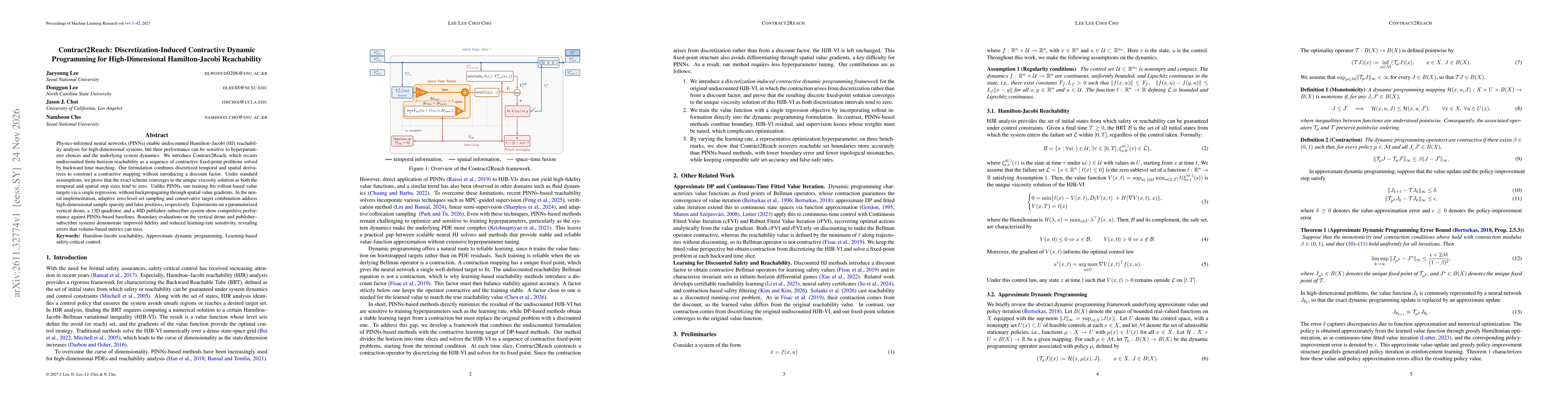
Physics-informed neural networks (PINNs) enable undiscounted Hamilton-Jacobi (HJ) reachability analysis for high-dimensional systems, but their performance can be sensitive to hyperparameter choices and the underlying system dynamics. We introduce Contract2Reach, which recasts undiscounted finite-horizon reachability as a sequence of contractive fixed-point problems solved by backward time marching. Our formulation combines discretized temporal and spatial derivatives to construct a contractive mapping without introducing a discount factor. Under standard assumptions, we prove that the exact scheme converges to the unique viscosity solution as both the temporal and spatial step sizes tend to zero. Unlike PINNs, our training fits rollout-based value targets via a single regression, without backpropagating through spatial value gradients. In the neural implementation, adaptive zero-level-set sampling and conservative target combination address high-dimensional sample sparsity and false positives, respectively. Experiments on a parameterized vertical drone, a 13D quadrotor, and a 40D publisher-subscriber system show competitive performance against PINNs-based baselines. Boundary evaluations on the vertical drone and publisher-subscriber systems demonstrate improved fidelity and reduced learning-rate sensitivity, revealing errors that volume-based metrics can miss.
AI Key Findings
Get AI-generated insights about this paper's methodology, results, significance, and more — available when analysis has been generated.
Discussion 0