Correlation function and bound state from the $K D_{s0}^*(2317)$ interaction
Abstract
In anticipation of the new wave of ALICE experiments on particle-resonance correlation functions, we study the interaction of a kaon with the $D_{s0}^*(2317)$ resonance. Assuming the $D_{s0}^*(2317)$ to be a $DK$ molecular state in isospin $I=0$, we employ the fixed center approximation (FCA) to describe the kaon scattering off the $DK$ cluster, and implement elastic unitarity in the $K D_{s0}^*(2317)$ amplitude via an optical potential and the Lippmann-Schwinger equation. We evaluate the scattering length, effective range, and correlation function, which exhibits a shape characteristic of a strongly attractive interaction. Notably, the amplitude develops a narrow resonant peak about 40~MeV below the $K D_{s0}^*(2317)$ threshold, signaling a three-body bound state. We discuss the experimental feasibility of observing this state through the invariant mass distribution of $K D_s^+ π^0$, and argue that such three-body states, predicted by various theoretical approaches, offer promising targets for future experimental searches, providing valuable insights into the nature of exotic hadronic resonances.
Analysis
AI-generated · verify against the original paper
Generated Apr 9, 2026ResultsWhat the authors found
- The K–D_s0(2317) scattering length is a=(0.517−0.00016i) fm and the effective range r0=(−0.511+0.102i) fm, indicating a strongly attractive interaction.
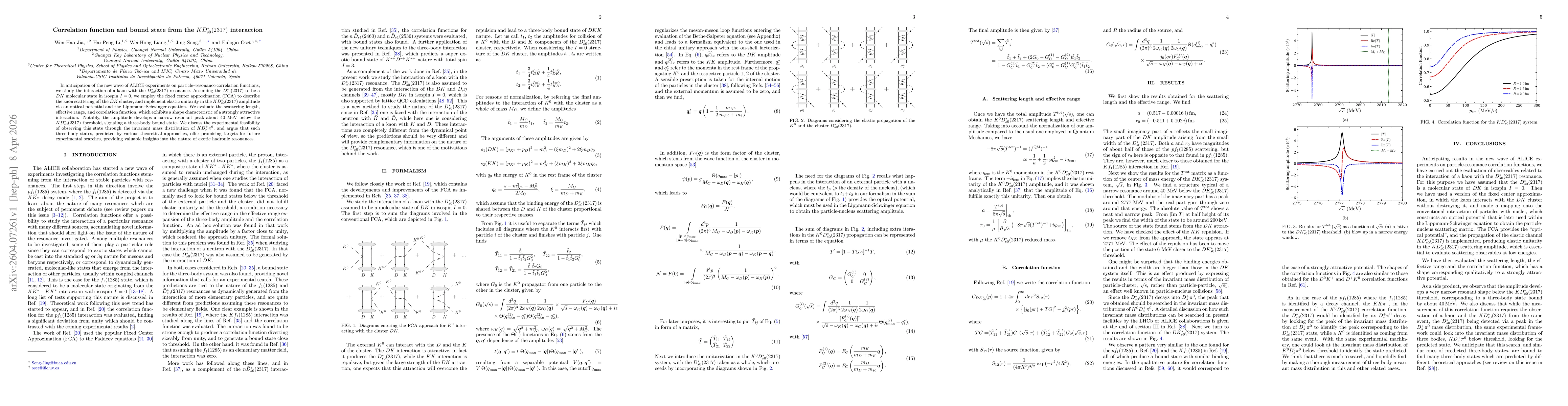
- The total amplitude shows a narrow resonance 40 MeV below the K–D_s0 threshold with a width of ≈200 keV, signalling a three‑body bound state.
- The correlation function displays a characteristic shape of a strongly attractive potential, similar to those found for f1(1285) and Kf1(1285) systems.
LimitationsWhere the findings need caution
- The analysis assumes D_s0(2317) is a pure DK molecule and neglects possible coupled‑channel effects beyond DK and K K interactions.
- The optical‑potential treatment uses a fixed‑center approximation, which may not fully capture dynamical breakup or higher‑order rescattering.
MethodologyHow the work was done
Fixed‑center approximation of a kaon scattering off a DK cluster, construction of an optical potential, solution of the Lippmann‑Schwinger equation, and calculation of scattering length, effective range and correlation function.
SignificanceWhy the work matters
The predicted three‑body bound state can be searched in ALICE and LHC experiments via the K D_s^+ π^0 invariant mass distribution, providing a test of the molecular nature of D_s0(2317) and advancing our understanding of exotic hadrons.
Technical contributionsWhat the work introduces
Implementation of a unified FCA–optical‑potential formalism for K–D_s0 scattering, enabling extraction of scattering observables and correlation functions in a framework directly comparable to femtoscopic measurements.
NoveltyHow it differs from prior work
First study linking the K–D_s0(2317) interaction to femtoscopic correlation functions and predicting a narrow three‑body bound state accessible to current heavy‑ion experiments.
Future workQuestions that remain
- Experimental measurement of the K D_s^+ π^0 invariant mass spectrum to confirm the predicted bound state.
- Extension of the FCA–optical‑potential framework to other three‑body systems such as K D_s1(2460) or B‑meson analogues.
Discussion 0