Cosmos 1.0: a multidimensional map of the emerging technology frontier
Researchers created a comprehensive dataset of 23,544 emerging technologies with multiple indices to assess their landscape, providing new insights into the tech frontier. The Cosmos 1.0 dataset offers a multidimensional map of emerging technologies, enabling better understanding and analysis of their development and impact.
Abstract
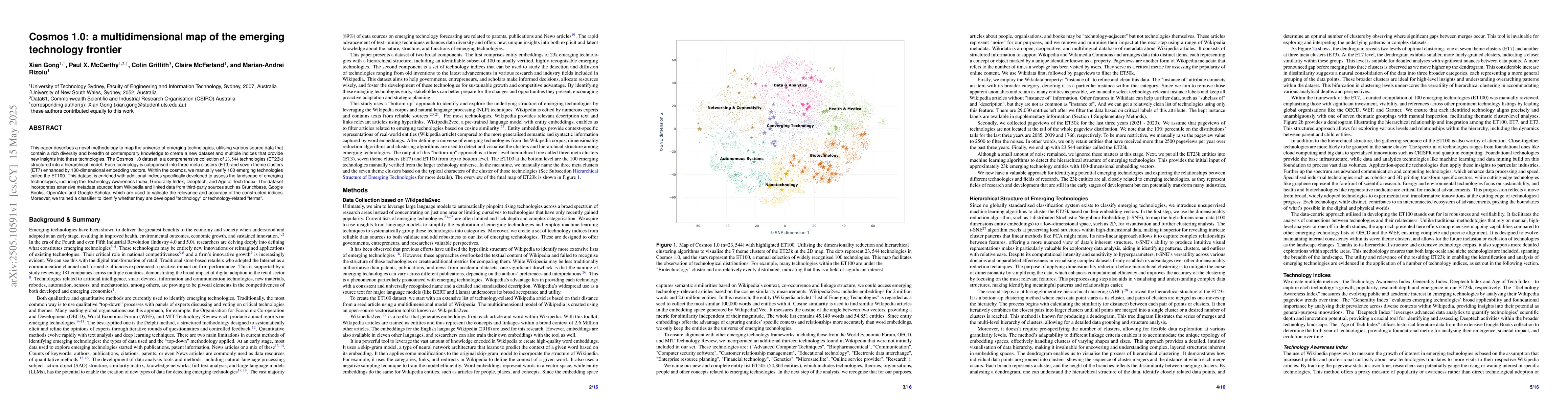
This paper describes a novel methodology to map the universe of emerging technologies, utilising various source data that contain a rich diversity and breadth of contemporary knowledge to create a new dataset and multiple indices that provide new insights into these technologies. The Cosmos 1.0 dataset is a comprehensive collection of 23,544 technologies (ET23k) structured into a hierarchical model. Each technology is categorised into three meta clusters (ET3) and seven theme clusters (ET7) enhanced by 100-dimensional embedding vectors. Within the cosmos, we manually verify 100 emerging technologies called the ET100. This dataset is enriched with additional indices specifically developed to assess the landscape of emerging technologies, including the Technology Awareness Index, Generality Index, Deeptech, and Age of Tech Index. The dataset incorporates extensive metadata sourced from Wikipedia and linked data from third-party sources such as Crunchbase, Google Books, OpenAlex and Google Scholar, which are used to validate the relevance and accuracy of the constructed indices. Moreover, we trained a classifier to identify whether they are developed "technology" or technology-related "terms".
Analysis
AI-generated · verify against the original paper
Generated Jun 8, 2025ResultsWhat the authors found
- Creation of Cosmos 1.0, a dataset containing 23,544 emerging technologies with a hierarchical structure and 100-dimensional embedding vectors.
- Development of specialized indices to analyze the emerging technology landscape, such as Technology Awareness Index and Age of Tech Index.
LimitationsWhere the findings need caution
- The manual verification of 100 emerging technologies (ET100) might not be scalable for a larger dataset.
- Reliance on existing data sources may introduce biases or gaps in the representation of certain technologies or regions.
MethodologyHow the work was done
The paper introduces Cosmos 1.0, a comprehensive dataset of 23,544 emerging technologies (ET23k) organized hierarchically into three meta clusters (ET3) and seven theme clusters (ET7), complemented by 100-dimensional embedding vectors. It also presents indices like Technology Awareness Index, Generality Index, Deeptech, and Age of Tech Index, enriched with metadata from sources including Wikipedia, Crunchbase, Google Books, OpenAlex, and Google Scholar.
SignificanceWhy the work matters
This research provides a novel methodology to map and analyze the diverse and rapidly evolving field of emerging technologies, offering valuable insights for researchers, policymakers, and industry stakeholders.
Technical contributionsWhat the work introduces
The development of Cosmos 1.0 dataset, along with innovative indices and a hierarchical categorization method, contributes to a more structured understanding of emerging technologies.
NoveltyHow it differs from prior work
Cosmos 1.0 stands out by integrating diverse source data, creating a multidimensional map, and introducing specialized indices to assess the emerging technology frontier, offering a novel approach to its analysis.
Future workQuestions that remain
- Expanding the manual verification process to cover a broader range of emerging technologies.
- Incorporating more diverse and global data sources to enhance the dataset's representativeness.
Discussion 0