Counterexamples to the clamped-plate eigenvalue ratio conjecture
Abstract
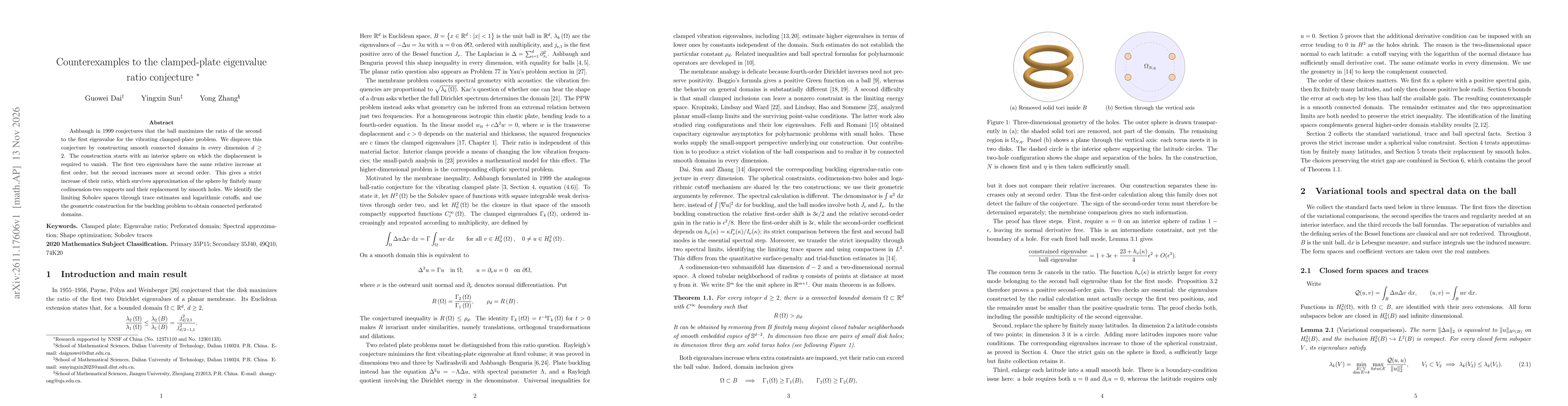
Ashbaugh in 1999 conjectures that the ball maximizes the ratio of the second to the first eigenvalue for the vibrating clamped-plate problem. We disprove this conjecture by constructing smooth connected domains in every dimension $d\ge2$. The construction starts with an interior sphere on which the displacement is required to vanish. The first two eigenvalues have the same relative increase at first order, but the second increases more at second order. This gives a strict increase of their ratio, which survives approximation of the sphere by finitely many codimension-two supports and their replacement by smooth holes. We identify the limiting Sobolev spaces through trace estimates and logarithmic cutoffs, and use the geometric construction for the buckling problem to obtain connected perforated domains.
Analysis
AI-generated · verify against the original paper
Generated Jan 1, 0001ResultsWhat the authors found
- The Ashbaugh clamped‑plate eigenvalue ratio conjecture is disproved by exhibiting domains where the ratio Γ2/Γ1 exceeds that of the ball.
- The first two eigenvalues have identical relative increase at first order, but the second eigenvalue increases more at second order, yielding a strict increase of their ratio.
- The construction works in every dimension d≥2 and survives approximation by codimension‑two supports and smooth perforations.
- The same geometric construction is applied to the buckling problem, providing connected perforated domains that violate the analogous conjecture.
LimitationsWhere the findings need caution
- The analysis relies on smooth approximations of interior spheres by finitely many codimension‑two supports, which may limit direct applicability to arbitrary rough domains.
- Results are established for dimensions d≥2; the one‑dimensional case is not addressed.
MethodologyHow the work was done
The authors construct smooth connected domains in every dimension d≥2 by starting with an interior sphere where the displacement vanishes, analyze first‑ and second‑order variations of the first two clamped‑plate eigenvalues, use trace estimates and logarithmic cutoffs to identify limiting Sobolev spaces, and approximate the interior sphere by finitely many codimension‑two supports that are replaced by smooth holes.
SignificanceWhy the work matters
This work provides the first counterexamples to a long‑standing conjecture in spectral geometry, showing that the ball does not maximize the clamped‑plate eigenvalue ratio, and introduces new techniques for handling Sobolev trace issues in perforated domains.
Technical contributionsWhat the work introduces
A novel geometric construction combined with trace estimates and logarithmic cutoffs that enables precise second‑order eigenvalue variation analysis in perforated domains.
NoveltyHow it differs from prior work
The paper introduces the first explicit smooth connected domains that violate the clamped‑plate eigenvalue ratio conjecture and adapts the construction to the buckling problem, providing new tools for shape optimization in higher‑order spectral problems.
Future workQuestions that remain
- Extending the counterexample methodology to other higher‑order eigenvalue ratio problems.
- Investigating optimal shapes for clamped‑plate eigenvalues under different geometric constraints.
Discussion 0