CriticJEPA: World Models Are Better Critics Than Optimizers
Abstract
Visual world models enable goal-directed planning by predicting action outcomes. Gradient-based planners optimize actions to lower predicted goal cost, but continued optimization can exploit prediction errors after execution stops improving. Comparing plans requires informative relative scores; improving them also requires reliable update directions. Exact-state execution reveals that a frozen hierarchical world model ranks goal-conditioned proposals even when its rankings among outputs of prolonged gradient search are uninformative. Effective planning pairs goal-directed candidates with predictions that distinguish their outcomes. We introduce CriticJEPA, which learns goal-conditioned flow proposals from reward-free trajectories and uses frozen rollouts to select among them at every hierarchy level. Forward selection forms a complete planner; short anchored updates refine candidates before selection. Across visual navigation and manipulation, CriticJEPA increases success at a fraction of the planning compute, transferring shared settings across independently trained models, hierarchy depths, and unseen tasks while keeping every world-model weight fixed.
Analysis
AI-generated · verify against the original paper
Generated Jan 1, 0001ResultsWhat the authors found
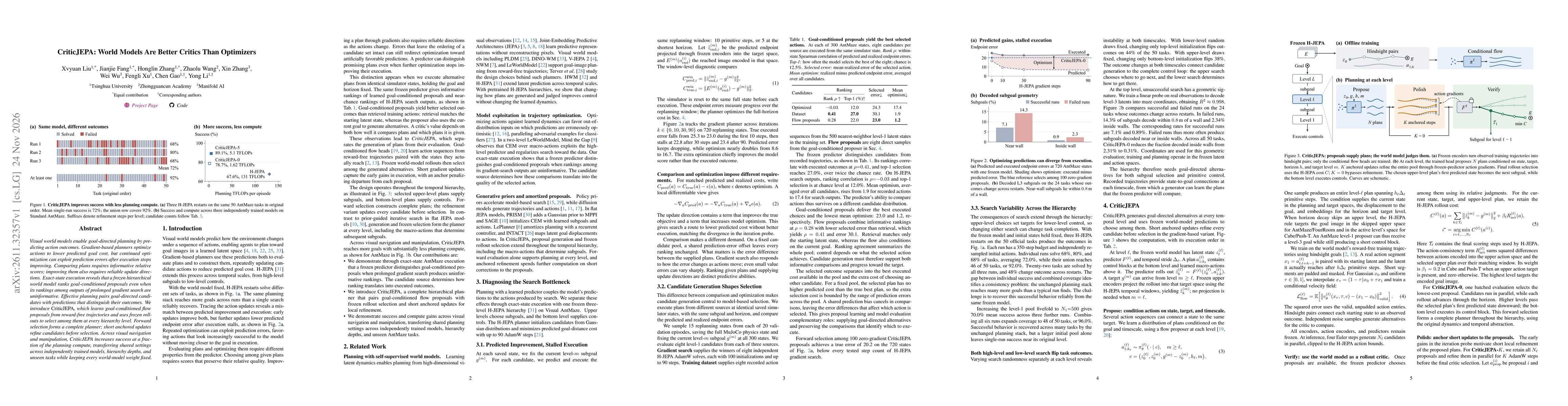
- CriticJEPA improves success rates on visual navigation and manipulation tasks while using a fraction of the planning compute (e.g., 5.1 TFLOPs vs 131 TFLOPs for H‑JEPA).
- Across AntMaze tasks, CriticJEPA achieves up to 92% success compared to 72% for single‑run baselines.
- The method transfers shared planning settings across independently trained models, different hierarchy depths, and unseen tasks without fine‑tuning world‑model weights.
MethodologyHow the work was done
CriticJEPA learns goal‑conditioned flow proposals from reward‑free trajectories, uses a frozen hierarchical world model to rollout each proposal, applies short anchored gradient updates for local refinement, and performs forward selection across hierarchy levels to construct complete plans.
SignificanceWhy the work matters
The work demonstrates that frozen world‑model predictions can serve as reliable critics, enabling efficient hierarchical planning that reduces computation while increasing task success, and shows broad transferability across models and tasks.
Technical contributionsWhat the work introduces
A complete hierarchical planner that separates proposal generation (via goal‑conditioned flow) from evaluation (via frozen rollouts) and introduces short anchored updates for refinement, all operating without updating world‑model parameters.
NoveltyHow it differs from prior work
Introducing a critic‑based planning paradigm where a fixed world model ranks goal‑conditioned proposals, combined with forward selection and anchored refinement, contrasting with traditional gradient‑based optimization that exploits model errors.
Discussion 0