Cross-Domain Adversarial Augmentation: Stabilizing GANs for Medical and Handwriting Data Scarcity
This study shows that using GAN-generated augmentations can boost diversity and classifier performance when training with limited data in two low-resource domains—Bangla handwriting and chest X-rays. It analyzes stability techniques (like gradient penalties and spectral normalization), evaluates with IS/FID and visualizations, and provides a practical, reproducible protocol while noting evaluation caveats, privacy risks, and licensing considerations for medical images.
Abstract
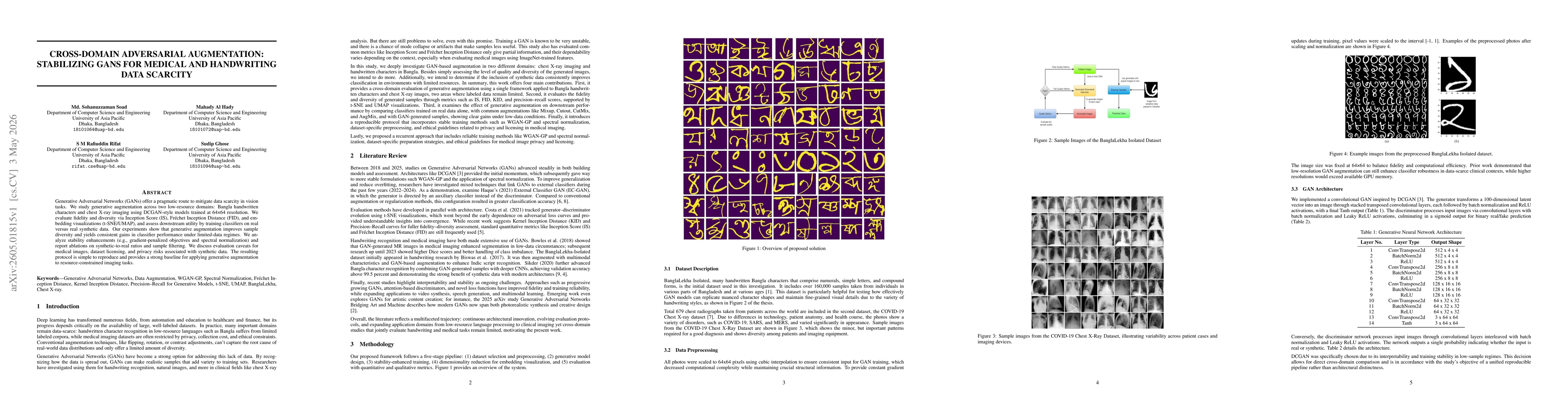
Generative Adversarial Networks (GANs) offer a pragmatic route to mitigate data scarcity in vision tasks. We study generative augmentation across two low-resource domains: Bangla handwritten characters and chest X-ray imaging using DCGAN-style models trained at 64x64 resolution. We evaluate fidelity and diversity via Inception Score (IS), Fr'echet Inception Distance (FID), and embedding visualizations (t-SNE/UMAP), and assess downstream utility by training classifiers on real versus real synthetic data. Our experiments show that generative augmentation improves sample diversity and yields consistent gains in classifier performance under limited-data regimes. We analyze stability enhancements (e.g., gradient-penalized objectives and spectral normalization) and report ablations on synthetic-to-real ratios and sample filtering. We discuss evaluation caveats for medical images, dataset licensing, and privacy risks associated with synthetic data. The resulting protocol is simple to reproduce and provides a strong baseline for applying generative augmentation to resource-constrained imaging tasks.
AI Key Findings
Get AI-generated insights about this paper's methodology, results, significance, and more — available when analysis has been generated.
Discussion 0