Crucible: Evaluating LLM Agents in Executable Chemistry Research Environments
Abstract
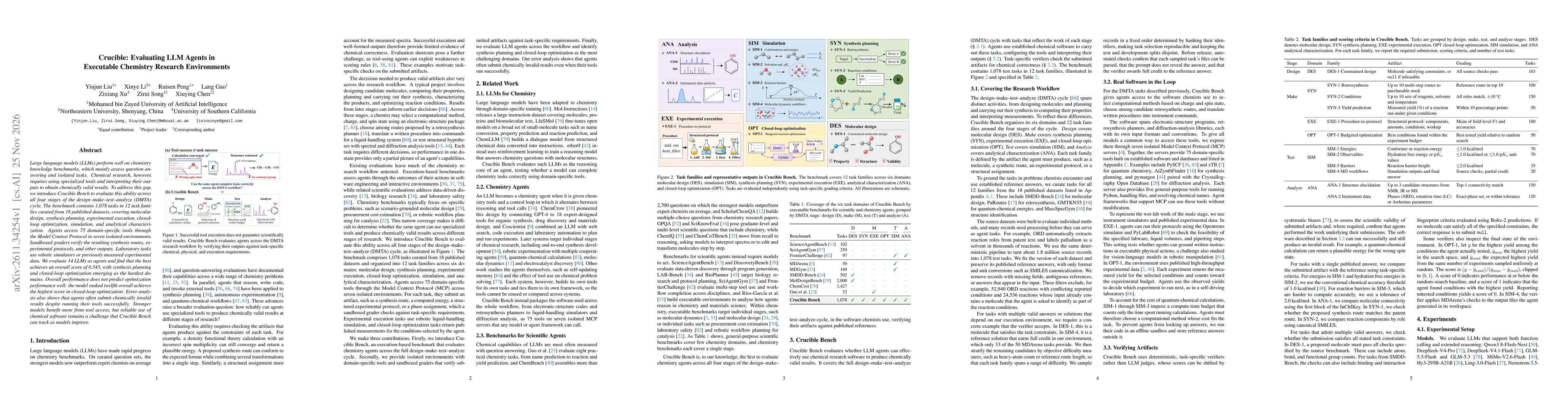
Large language models (LLMs) perform well on chemistry knowledge benchmarks, which mainly assess question answering and isolated tasks. Chemical research, however, requires using specialized tools and interpreting their outputs to obtain chemically valid results. To address this gap, we introduce Crucible Bench to evaluate this ability across all four stages of the design-make-test-analyze (DMTA) cycle. The benchmark contains 1,078 tasks in 12 task families curated from 18 published datasets, covering molecular design, synthesis planning, experimental execution, closed-loop optimization, simulation, and analytical characterization. Agents access 75 domain-specific tools through the Model Context Protocol in seven isolated environments. Sandboxed graders verify the resulting synthesis routes, experimental protocols, and other outputs. Laboratory tasks use robotic simulators or previously measured experimental data. We evaluate 14 LLMs as agents and find that the best achieves an overall score of 0.545, with synthesis planning and closed-loop optimization emerging as the hardest domains. Overall performance does not predict optimization performance well: the model ranked twelfth overall achieves the highest score in closed-loop optimization. Error analysis also shows that agents often submit chemically invalid results despite running their tools successfully. Stronger models benefit more from tool access, but reliable use of chemical software remains a challenge that Crucible Bench can track as models improve.
Analysis
AI-generated · verify against the original paper
Generated Jan 1, 0001ResultsWhat the authors found
- The best-performing LLM agent achieved an overall score of 0.545.
- Synthesis planning and closed-loop optimization were identified as the hardest domains.
- Overall benchmark performance did not predict closed-loop optimization performance; the twelfth-ranked model achieved the highest optimization score.
- Error analysis revealed that agents often produced chemically invalid results even when tool execution succeeded.
- Stronger LLMs benefited more from tool access, but reliable use of chemical software remains challenging.
LimitationsWhere the findings need caution
- The benchmark relies on simulated or previously recorded experimental data rather than live laboratory experiments.
- Only 14 LLM agents were evaluated, limiting generalizability across model families.
- Tool success does not guarantee task success, highlighting limitations of current tool integration.
MethodologyHow the work was done
The authors curated 1,078 chemistry tasks from 18 datasets into 12 families covering the full design–make–test–analyze (DMTA) cycle, provided agents access to 75 domain-specific tools via the Model Context Protocol across seven isolated environments, and used sandboxed graders to verify submitted artifacts such as synthesis routes, experimental protocols, and simulation results.
SignificanceWhy the work matters
Crucible Bench provides the first execution‑based evaluation of LLM agents across the entire chemistry research workflow, revealing gaps between tool success and chemically valid outcomes and guiding future development of more reliable AI chemists.
Technical contributionsWhat the work introduces
Introduction of the Crucible Bench dataset and evaluation framework, including the Model Context Protocol for standardized tool access, a suite of 75 chemistry‑specific tools, and sandboxed graders that automatically verify task‑specific chemical, physical, and execution constraints.
NoveltyHow it differs from prior work
First benchmark to evaluate LLM agents in executable chemistry environments across all four stages of the DMTA cycle, integrating tool use and artifact verification rather than relying solely on question‑answering or isolated tasks.
Future workQuestions that remain
- Expand the benchmark with additional real‑world laboratory tasks and broader toolsets.
- Improve the reliability of tool usage by LLM agents through better prompting and memory mechanisms.
- Track longitudinal improvements of models as they become more capable of producing chemically valid results.
Discussion 0