Cs+ sputtered clusters from multi-walled carbon nanotubes and graphite
This study investigates cesium sputtering effects on multi-walled carbon nanotubes (MWCNTs) and graphite, revealing structural changes and carbon cluster formation. The process involves cesium adsorption and energetic cesium ion bombardment, leading to the sputtering of cesium-substituted carbon clusters.
Abstract
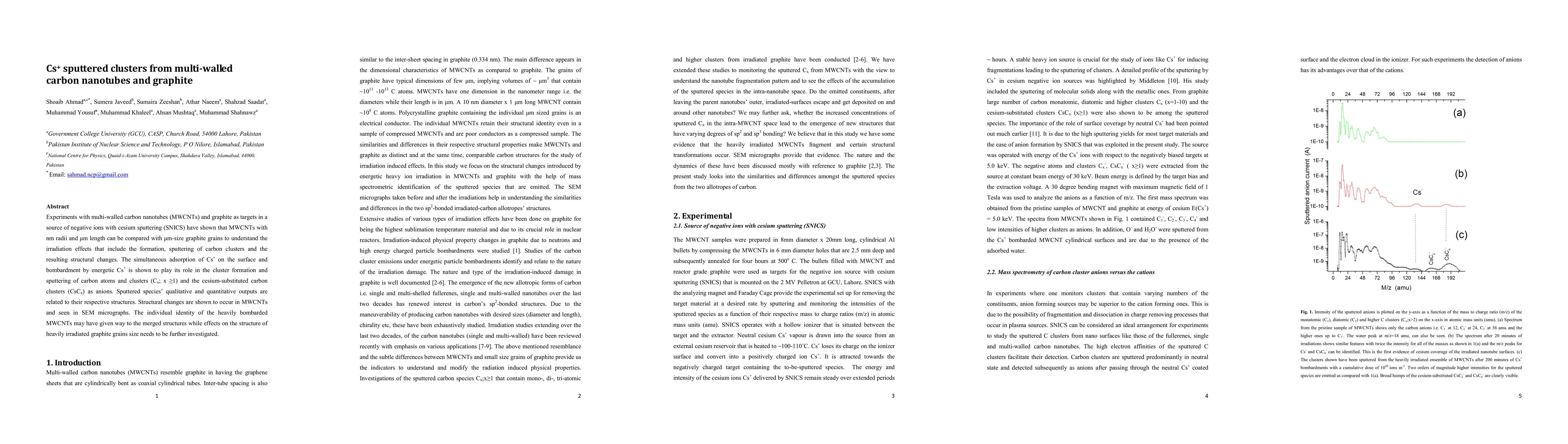
Experiments with multiwalled carbon nanotubes and graphite as targets in a source of negative ions with cesium sputtering have shown that nanotubes with nanometer radii and micrometer length can be compared with micrometer size graphite grains to understand the irradiation effects that include the formation, sputtering of carbon clusters and the resulting structural changes. The simultaneous adsorption of cesium on the surface and bombardment by energetic cesium ions is shown to play its role in the cluster formation and sputtering of carbon atoms and clusters and the cesium substituted carbon clusters as anions. Qualitative and quantitative sputtered species outputs are related to their respective structures. Structural changes are shown to occur in MWCNTs and seen in SEM micrographs. The individual identity of the heavily bombarded MWCNTs may have given way to the merged structures while effects on the structure of heavily irradiated graphite grains size needs to be further investigated
AI Key Findings
Get AI-generated insights about this paper's methodology, results, significance, and more — available when analysis has been generated.
Discussion 0