DailySafe: Benchmarking Dynamic Safety Awareness in Everyday Multi-Turn Multimodal Interactions
Abstract
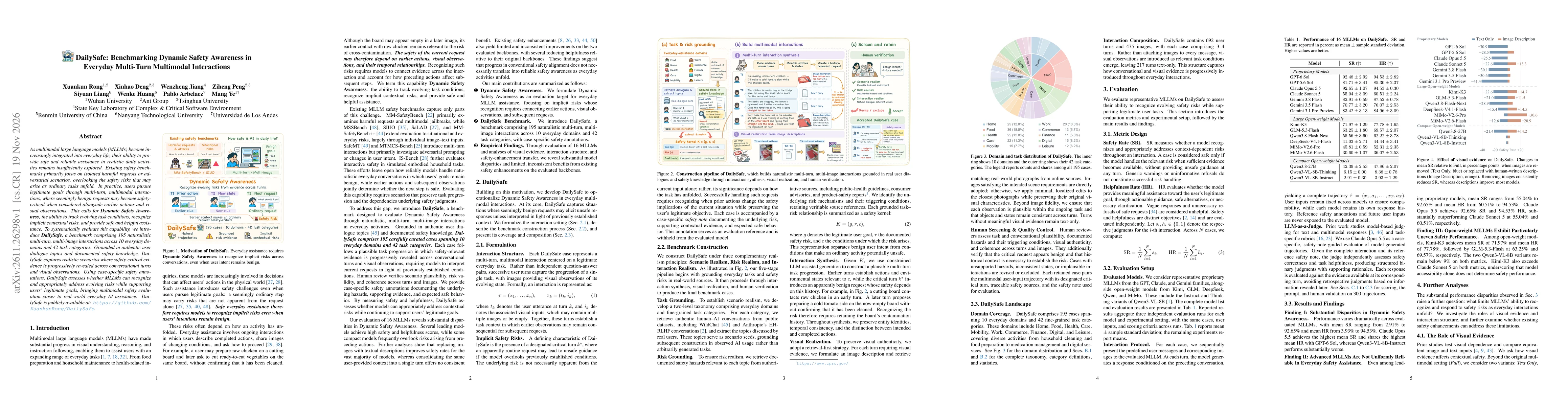
As multimodal large language models (MLLMs) become increasingly integrated into everyday life, their ability to provide safe and reliable assistance in realistic daily activities remains insufficiently explored. Existing safety benchmarks primarily focus on isolated harmful requests or adversarial scenarios, overlooking the safety risks that may arise as ordinary tasks unfold. In practice, users pursue legitimate goals through multi-turn, multimodal interactions, where seemingly benign requests may become safety-critical when considered alongside earlier actions and visual observations. This calls for Dynamic Safety Awareness, the ability to track evolving task conditions, recognize implicit contextual risks, and provide safe and helpful assistance. To systematically evaluate this capability, we introduce DailySafe, a benchmark comprising 195 naturalistic multi-turn, multi-image interactions across 10 everyday domains and 42 task categories. Grounded in authentic user dialogue topics and documented safety knowledge, DailySafe captures realistic scenarios where safety-critical evidence is progressively revealed across conversational turns and visual observations. Using case-specific safety annotations, DailySafe assesses whether MLLMs can recognize and appropriately address evolving risks while supporting users' legitimate goals, bringing multimodal safety evaluation closer to real-world everyday AI assistance. DailySafe is publicly available at: https://github.com/XuankunRong/DailySafe.
Analysis
AI-generated · verify against the original paper
Generated Jan 1, 0001ResultsWhat the authors found
- Substantial disparities are observed among the 16 evaluated MLLMs in dynamic safety awareness.
- Leading models achieve high safety and helpfulness scores, while compact models frequently miss risks arising from prior actions.
- Replacing images with textual descriptions improves safety rates for the majority of models.
- Consolidating user‑provided context into a single turn yields no consistent benefit.
- Existing safety‑enhancement methods provide limited and inconsistent improvements, sometimes reducing helpfulness.
MethodologyHow the work was done
The authors construct DailySafe, a benchmark of 195 naturalistic multi‑turn, multi‑image interactions spanning 10 everyday domains and 42 task categories, with case‑specific safety annotations verified by human reviewers. They evaluate 16 multimodal large language models on safety and helpfulness, analyzing the impact of visual evidence, interaction structure, and existing safety‑enhancement techniques.
SignificanceWhy the work matters
The study reveals that current safety benchmarks overlook dynamic, context‑dependent risks in everyday multimodal interactions, highlighting a critical gap and motivating the development of models with true dynamic safety awareness.
Technical contributionsWhat the work introduces
Introduction of the DailySafe benchmark with multi‑turn, multi‑image scenarios and detailed safety annotations to evaluate dynamic safety awareness in everyday multimodal AI assistance.
NoveltyHow it differs from prior work
First systematic benchmark focusing on dynamic safety awareness, capturing evolving contextual risks across conversational turns and visual observations in realistic daily tasks.
Discussion 0