DataForgeVLA: Fully Synthetic Manipulation Demonstrations for Vision-Language-Action Training
Abstract
We present a dataset of 340 fully synthetic manipulation demonstrations generated from real seed data for Vision-Language-Action (VLA) training. The corpus contains 32,340 frames with synchronized RGB and actions across eight object categories, represented as LeRobot v2.1 episodes with H.264 video, per-frame robot states and pose-valued action labels, language task annotations, summary statistics and quality decisions. Each synthetic demonstration is produced without additional teleoperation: a LoRA-fine-tuned Cosmos-3 model generates a manipulation video, and RoboHaMeR recovers the corresponding robot trajectory from RGB. Quality screening accepted 300 of 340 episodes for policy fine-tuning. As preliminary evidence of feasibility, a pretrained GR00T N1.6 policy fine-tuned exclusively on the 300 accepted episodes reaches 16/20 (80%) real-world pick-and-place success on the Oreo-package task. A policy fine-tuned on 105 real teleoperated episodes achieved 18/20 (90%) under the same protocol. These results are based on one object and 20 trials per policy and are therefore reported as preliminary evidence rather than a general performance claim.
Analysis
AI-generated · verify against the original paper
Generated Jan 1, 0001ResultsWhat the authors found
- A GR00TN1.6 policy fine‑tuned on the 300 screened synthetic episodes achieved 16/20 (80%) real‑world pick‑and‑place success on the Oreo‑package task.
- A comparable policy fine‑tuned on 105 real teleoperated episodes achieved 18/20 (90%) success under the same protocol.
LimitationsWhere the findings need caution
- Results are based on a single object type and only 20 trials per policy, limiting generality.
- Scene diversity is confined to eight object categories and a single robot/camera setup.
- Potential error sources include implausible motion from the Cosmos‑3 video model and inaccuracies in RoboHaMeR trajectory recovery.
- No controlled ablations isolate the impact of scene recomposition, synthesis strategies, or quality filtering.
- The full generation and action‑extraction code and execution configurations are not released, hindering independent reproduction.
MethodologyHow the work was done
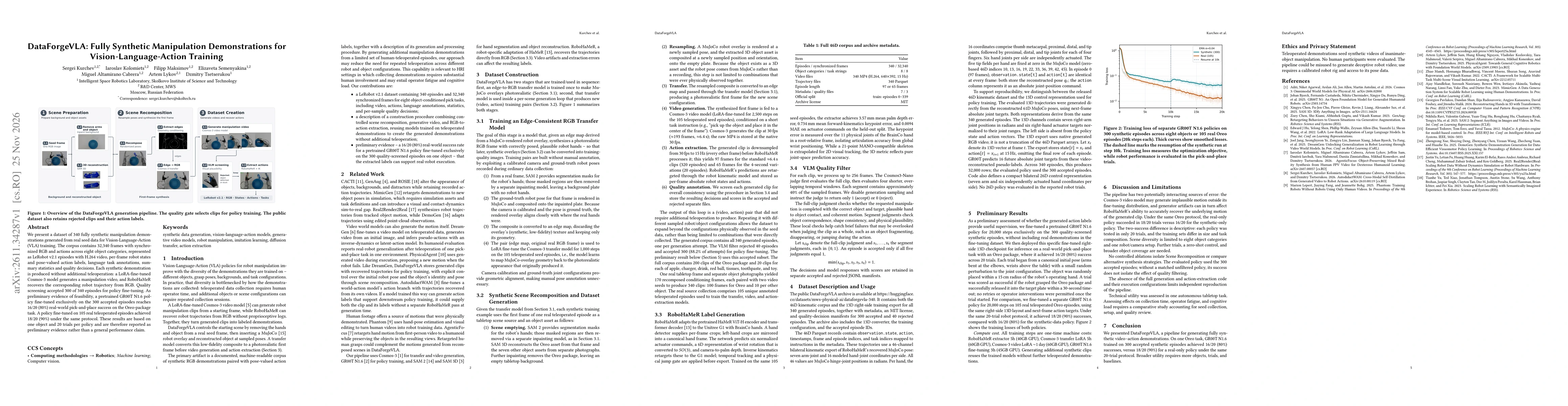
The authors construct a pipeline that starts from real teleoperated seed frames, removes hands and objects using SAM2, inpaints the background, reconstructs 3D object models with SAM3D, and recomposes scenes with randomized poses. A LoRA‑fine‑tuned Cosmos‑3 model transfers edge maps of MuJoCo overlays into photorealistic RGB frames, which are then used by Cosmos‑3 to generate manipulation videos. RoboHaMeR recovers robot trajectories directly from the RGB videos, producing pose‑valued action labels. Quality screening selects 300 of 340 synthetic episodes for policy fine‑tuning.
SignificanceWhy the work matters
The work demonstrates that fully synthetic manipulation demonstrations can provide useful supervision for Vision‑Language‑Action policies, potentially reducing the need for extensive teleoperated data collection and operator effort.
Technical contributionsWhat the work introduces
A publicly available LeRobot v2.1 dataset of 340 synthetic manipulation episodes (32,340 synchronized RGB frames) with per‑frame robot states, pose‑valued action labels, language task annotations, and quality decisions, together with a generation pipeline that combines controlled scene recomposition, a LoRA‑adapted Cosmos‑3 video model, and RGB‑to‑action extraction via RoboHaMeR.
NoveltyHow it differs from prior work
First fully synthetic manipulation demonstration corpus for Vision‑Language‑Action training that generates both video and corresponding robot action labels without any additional teleoperation, leveraging generative video models and RGB‑based trajectory recovery.
Future workQuestions that remain
- Expand the dataset to cover more objects, tasks, and robot/camera configurations.
- Conduct larger‑scale trials, zero‑shot control experiments, and comparative studies of collection time and operator fatigue.
- Perform ablation studies to isolate the contributions of scene recomposition and synthesis components.
- Release the full pipeline code and configurations to enable reproducibility.
- Investigate broader utility of synthetic data for autonomous tabletop tasks beyond the single Oreo‑package scenario.
Discussion 0