DCRL: Decoupling and Coupling Reinforcement Learning via Policy-Reward Manifold Alignment
Abstract
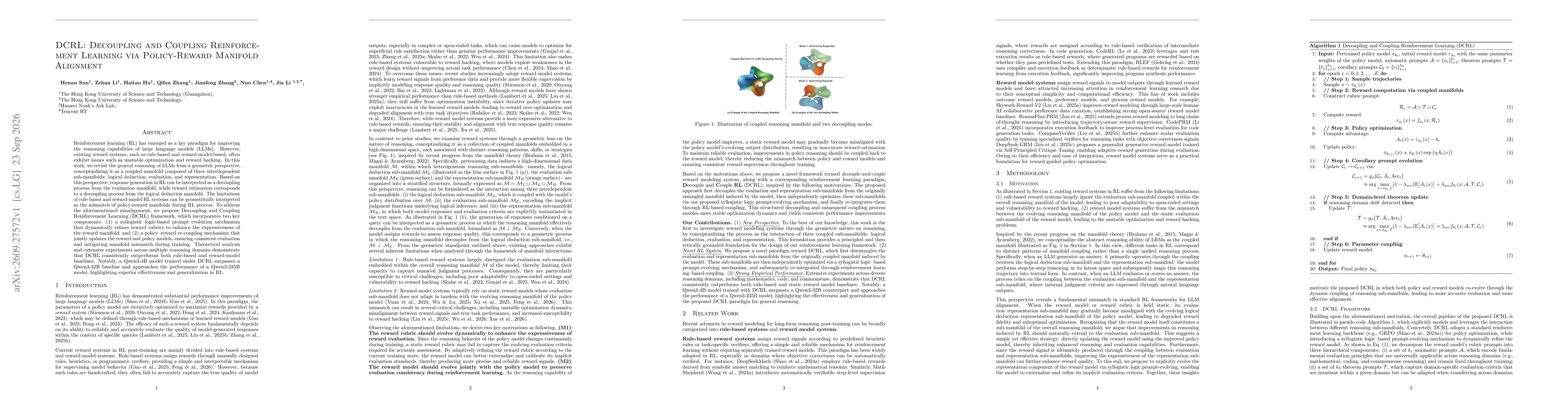
Reinforcement learning (RL) has emerged as a key paradigm for improving the reasoning capabilities of large language models (LLMs). However, existing reward systems, such as rule-based and reward-model-based, often exhibit issues such as unstable optimization and reward hacking. In this work, we revisit the general reasoning of LLMs from a geometric perspective, conceptualizing it as a coupled manifold composed of three interdependent sub-manifolds: logical deduction, evaluation, and representation. Based on this perspective, response generation in RL can be interpreted as a decoupling process from the evaluation manifold, while reward estimation corresponds to a decoupling process from the logical deduction manifold. The limitations of rule-based and reward-model RL systems can be geometrically interpreted as the mismatch of policy-reward manifolds during RL process. To address the aforementioned misalignment, we propose Decoupling and Coupling Reinforcement Learning (DCRL) framework, which incorporates two key components: (1) a syllogistic logic-based prompt evolution mechanism that dynamically refines reward rubrics to enhance the expressiveness of the reward manifold; and (2) a policy-reward re-coupling mechanism that jointly updates the reward and policy models, ensuring consistent evaluation and mitigating manifold mismatch during training. Theoretical analysis and extensive experiments across multiple reasoning domains demonstrate that DCRL consistently outperforms both rule-based and reward-model baselines. Notably, a Qwen3-4B model trained under DCRL surpasses a Qwen3-32B baseline and approaches the performance of a Qwen3-235B model, highlighting superior effectiveness and generalization in RL.
AI Key Findings
Get AI-generated insights about this paper's methodology, results, significance, and more — available when analysis has been generated.
Discussion 0