Decision Columns as an Index: Interpretable Embeddings for Explainable Entity Matching and Search
Abstract
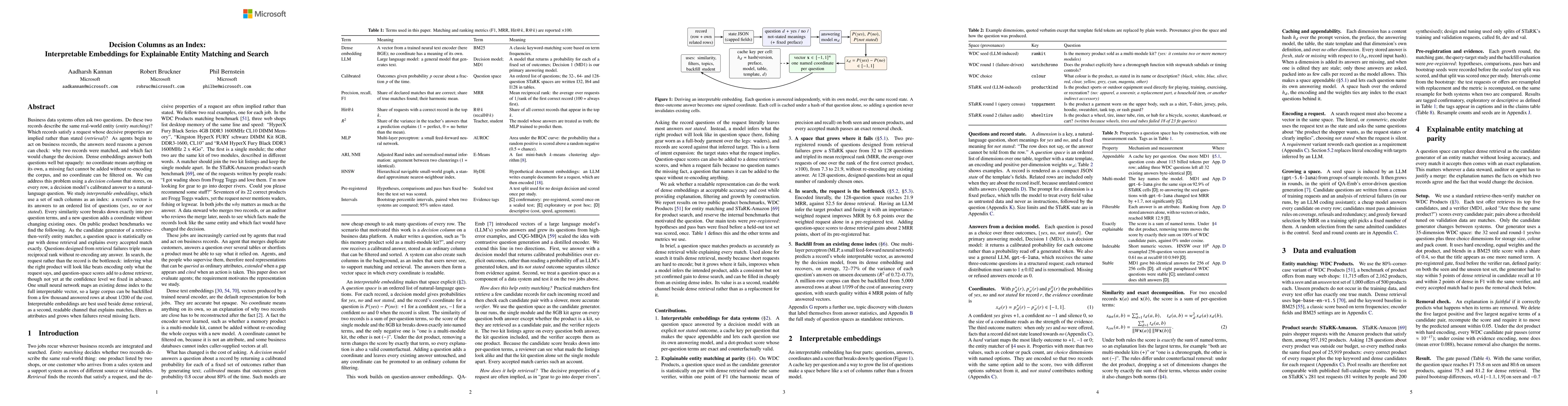
Business data systems must determine whether records refer to the same entity and retrieve records satisfying requests whose decisive properties are implicit. As agents act on these records, both tasks require auditable reasons. Dense embeddings perform well but offer opaque coordinates, cannot be filtered by meaning, and require corpus re-encoding to add new properties. We propose interpretable embeddings built from decision columns: each column stores a decision model's calibrated answer to a natural-language question, with outcomes yes, no, or not stated. A record's embedding is its answers across an ordered set of questions. Similarity decomposes exactly into per-question contributions, and new questions add coordinates without altering existing ones. On public product benchmarks, question-space retrieval matches dense candidate generation statistically in a retrieve-then-verify entity matcher, while providing exact explanations for accepted matches. Questions derived from retrieval failures triple mean reciprocal rank without re-encoding prior answers. For search, inferring the attributes of a suitable result outperforms encoding only the literal request, and combining question-space and dense scores improves retrieval, though not at our prespecified confidence threshold. A single small neural network predicts the full interpretable vector from an existing dense embedding, enabling corpus backfilling from a few thousand labeled rows at roughly 1/200 the cost. We position interpretable embeddings as a complementary, readable retrieval channel for explaining matches, filtering on attributes, and extending indexes as failures expose missing facts.
Analysis
AI-generated · verify against the original paper
Generated Jan 1, 0001ResultsWhat the authors found
- On public product benchmarks, the question‑space candidate generator is statistically on par with dense retrieval while providing exact explanations for every accepted match.
- Designing questions from retrieval failures triples mean reciprocal rank (MRR) without re‑encoding prior answers.
- In search, inferring the attributes of a suitable result outperforms encoding only the literal request, and combining question‑space and dense scores improves retrieval though not yet at the preset confidence threshold.
- A small neural network can map dense embeddings to the full interpretable vector, enabling corpus backfilling from a few thousand labeled rows at roughly 1/200 the cost.
LimitationsWhere the findings need caution
- The combined question‑space and dense scores do not consistently meet the predefined confidence level for retrieval.
- Evaluations are limited to public product matching and search benchmarks; broader domain applicability remains untested.
MethodologyHow the work was done
The authors construct interpretable embeddings by storing calibrated answers (yes, no, not stated) from decision models for a set of natural-language questions as columns per record. Similarity is computed as a sum of per‑question contributions, and new questions add dimensions without altering existing ones. Experiments use public product matching and search benchmarks, evaluating the question‑space as a candidate generator in a retrieve‑then‑verify matcher and as a retrieval channel, and train a small neural network to predict the full interpretable vector from dense embeddings for backfilling.
SignificanceWhy the work matters
Interpretable embeddings offer a readable, auditable retrieval channel that complements dense vectors, enabling attribute‑based filtering, exact match explanations, and incremental index extension without costly re‑encoding.
Technical contributionsWhat the work introduces
Introduction of decision‑column based interpretable embeddings that serve as an index, providing per‑question similarity decomposition and allowing seamless addition of new attributes without re‑encoding the corpus.
NoveltyHow it differs from prior work
A decomposable similarity metric where each dimension corresponds to a calibrated natural‑language question, enabling exact explanations, incremental index growth, and low‑cost backfilling from dense embeddings.
Future workQuestions that remain
- Improve confidence calibration to achieve the target confidence thresholds when merging question‑space and dense scores.
- Extend the approach to other data domains and larger-scale real‑world systems.
- Explore tighter integration with large language models for richer question generation and answer calibration.
Discussion 0