Decoupled Knowledge Retrieval and Compact Memory Enable Reliable Lifelong Model Editing
Abstract
Lifelong model editing requires continuously incorporating new facts into deployed large language models (LLMs) without expensive retraining or compromising existing capabilities. Memory-based editors offer an appealing solution by keeping the base parameters untouched, yet their practical use is hindered by linearly growing storage requirements and deteriorating retrieval performance as edits accumulate. To tackle these problems, we introduce BiSpace, a lifelong model editing framework that decouples memory retrieval from knowledge injection across two distinct representation spaces. BiSpace routes queries and identifies relevant edits in an external semantic space, while injecting the corresponding knowledge into the internal representation space of the LLM through sparse and storage-efficient updates. Extensive experiments show that BiSpace shrinks each entry's storage to only about 10.2% of the original and shows strong resilience to long edit sequences of up to 16K edits. On a more challenging benchmark, BiSpace further improves Overall Performance by more than 23% over existing methods. These results advance memory-based editing toward reliable long-term model maintenance at scale.
Analysis
AI-generated · verify against the original paper
Generated Jan 1, 0001ResultsWhat the authors found
- BiSpace reduces each edit entry's storage to about 10.2% of the original size.
- The framework remains robust for long edit sequences of up to 16K edits.
- On a challenging benchmark, BiSpace improves overall performance by more than 23% compared to existing methods.
MethodologyHow the work was done
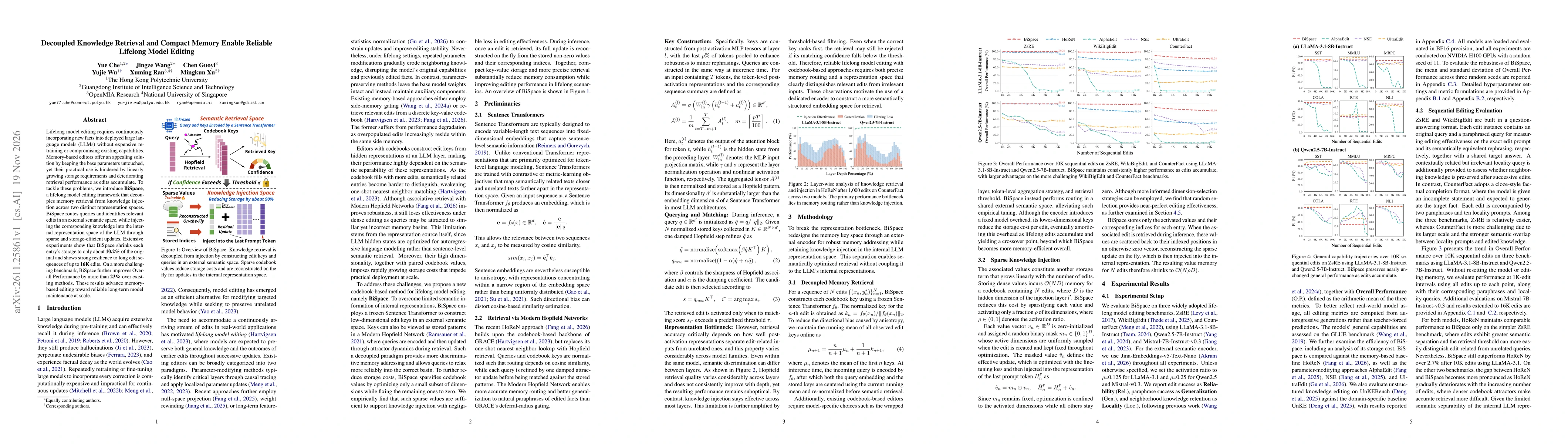
BiSpace decouples memory retrieval from knowledge injection by using a frozen SentenceTransformer to encode edit keys and queries in an external semantic space and a modern Hopfield network for retrieval, while injecting knowledge into the LLM's internal representation space via sparse, storage‑efficient codebook updates that are reconstructed on‑the‑fly.
SignificanceWhy the work matters
The work advances memory‑based model editing toward reliable, scalable lifelong maintenance of large language models without retraining or degrading existing capabilities.
Technical contributionsWhat the work introduces
Introduces a two‑space architecture that separates semantic retrieval from internal knowledge injection, employs sparse codebook values to achieve a ~90% reduction in memory consumption, and leverages modern Hopfield networks for precise retrieval in lifelong editing scenarios.
NoveltyHow it differs from prior work
First approach to decouple external semantic retrieval from internal LLM injection, enabling compact memory storage and sustained editing performance over thousands of updates.
Discussion 0