Decoupled Mode Connectivity for Base-to-Novel Generalization in Vision-Language Models
Abstract
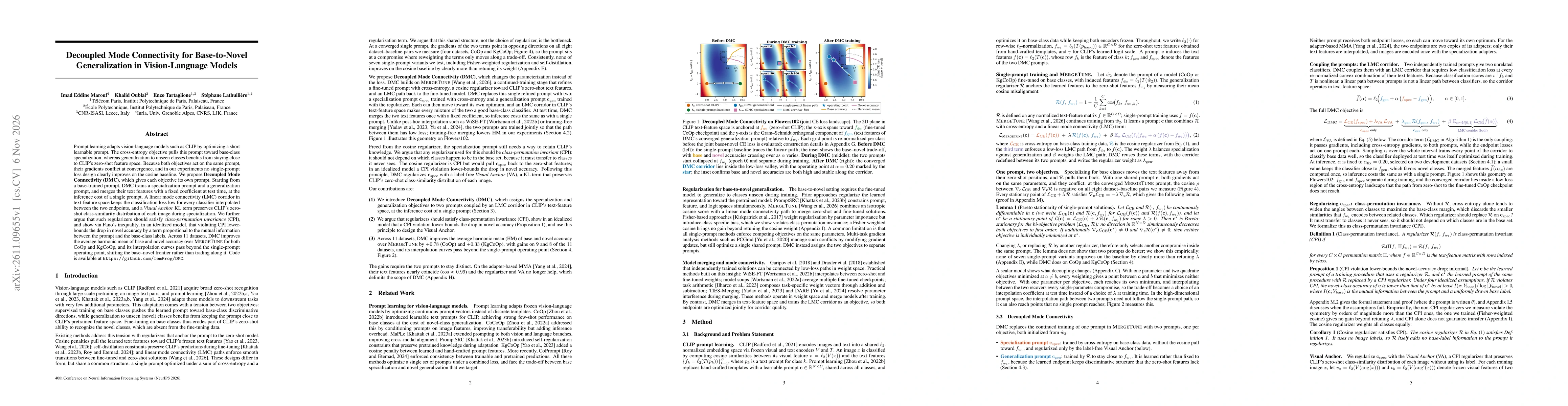
Prompt learning adapts vision-language models such as CLIP by optimizing a short learnable prompt. The cross-entropy objective pulls this prompt toward base-class specialization, whereas generalization to unseen classes benefits from staying close to CLIP's zero-shot feature space. Because both objectives act on the same prompt, their gradients conflict at convergence, and in our experiments no single-prompt loss design clearly improves on the cosine baseline. We propose Decoupled Mode Connectivity (DMC), which gives each objective its own prompt. Starting from a base-trained prompt, DMC trains a specialization prompt and a generalization prompt, and merges their text features with a fixed coefficient at test time, at the inference cost of a single prompt. A linear mode connectivity (LMC) corridor in text-feature space keeps the classification loss low for every classifier interpolated between the two endpoints, and a Visual Anchor KL term preserves CLIP's zero-shot class-similarity distribution of each image during specialization. We further argue that such regularizers should satisfy class-permutation invariance (CPI), and show via Fano's inequality, in an idealized model, that violating CPI lower-bounds the drop in novel accuracy by a term proportional to the mutual information between the prompt and the base-class labels. Across 11 datasets, DMC improves the average harmonic mean of base and novel accuracy over MergeTune for both CoOp and KgCoOp, and its interpolation curves pass beyond the single-prompt operating point, shifting the base-novel frontier rather than trading along it. Code is available at https://github.com/IemProg/DMC.
Analysis
AI-generated · verify against the original paper
Generated Jan 1, 0001ResultsWhat the authors found
- Across 11 datasets, DMC improves the average harmonic mean of base and novel accuracy over MergeTune by +0.78 for CoOp and +0.33 for KgCoOp.
- Gains are observed on 9 of the 11 datasets for CoOp and 8 of the 11 datasets for KgCoOp.
- Interpolation curves of DMC pass beyond the single‑prompt operating point, shifting the base‑novel frontier rather than merely trading off along it.
LimitationsWhere the findings need caution
- The approach requires the two prompts to remain distinct; when they become nearly identical (cosine ≈ 0.99) the Visual Anchor and regularizer no longer provide benefit, limiting DMC's applicability.
- Effectiveness depends on the CPI property of regularizers, which may restrict the choice of regularization techniques.
MethodologyHow the work was done
The paper proposes Decoupled Mode Connectivity (DMC), which assigns a specialization prompt trained with cross‑entropy loss and a generalization prompt trained with a regularizer, linking them via a linear mode connectivity (LMC) corridor in CLIP's text‑feature space; at test time the two text features are merged with a fixed coefficient, incurring the inference cost of a single prompt. Regularization includes a Visual Anchor KL term that preserves CLIP's zero‑shot class‑similarity distribution, and the design is guided by a class‑permutation invariance (CPI) principle.
SignificanceWhy the work matters
DMC resolves the gradient conflict between base‑class specialization and novel‑class generalization in prompt learning, achieving better base‑to‑novel transfer without additional inference overhead, and provides a theoretically grounded regularization framework based on CPI and Fano's inequality.
Technical contributionsWhat the work introduces
Introduction of the Decoupled Mode Connectivity framework with separate specialization and generalization prompts, a linear mode connectivity corridor for low‑loss interpolation, the class‑permutation invariance principle, and a label‑free Visual Anchor KL regularizer, accompanied by a theoretical analysis using Fano's inequality.
NoveltyHow it differs from prior work
Decoupling the competing objectives of prompt learning into two dedicated prompts linked by a mode‑connectivity path, combined with a CPI‑satisfying regularizer, represents a new paradigm that departs from prior single‑prompt loss designs.
Discussion 0