Decoupling Direction and Magnitude: Language-Steered Flow Matching for Super-Resolution in the Dark
Abstract
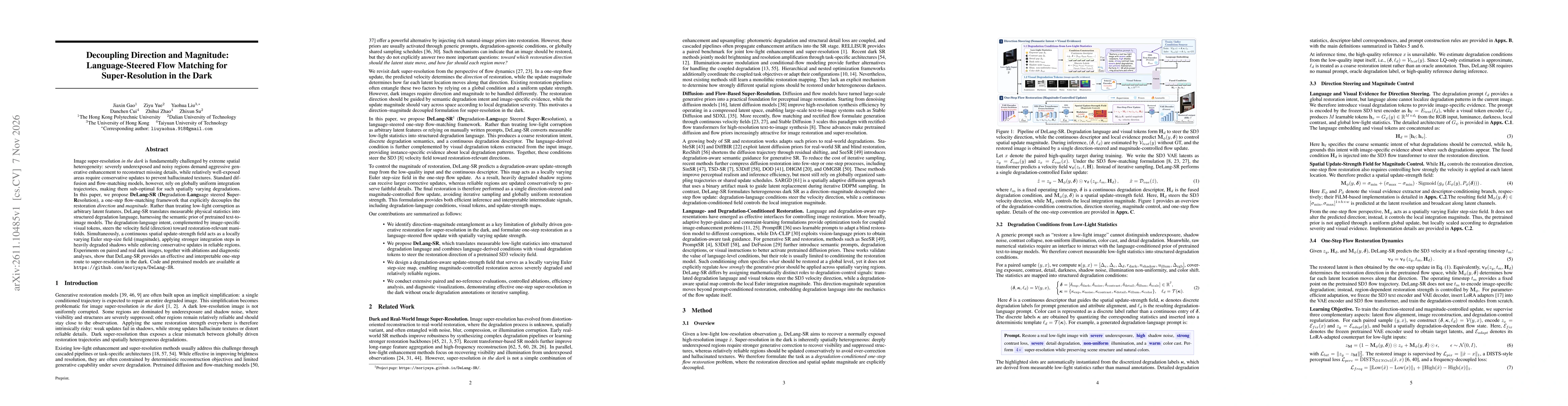
Image super-resolution in the dark is fundamentally challenged by extreme spatial heterogeneity: severely underexposed and noisy regions demand aggressive generative enhancement to reconstruct missing details, while relatively well-exposed areas require conservative updates to prevent hallucinated textures. Standard diffusion and flow-matching models, however, rely on globally uniform integration trajectories, making them sub-optimal for such spatially varying degradations. In this paper, we propose DeLang-SR (Degradation-Language steered Super-Resolution), a one-step flow-matching framework that explicitly decouples the restoration direction and magnitude. Rather than treating low-light corruption as arbitrary latent features, DeLang-SR translates measurable physical statistics into structured degradation language, harnessing the semantic prior of pretrained text-to-image models. The degradation-language intent, complemented by image-specific visual tokens, steers the velocity field (direction) toward restoration-relevant manifolds. Simultaneously, a continuous spatial update-strength field acts as a locally varying Euler step-size field (magnitude), applying stronger integration steps in heavily degraded shadows while enforcing conservative updates in reliable regions. Experiments on paired and real dark images, together with ablations and diagnostic analyses, show that DeLang-SR provides an effective and interpretable one-step route to super-resolution in the dark. Code and pretrained models are available at https://github.com/moriyaya/DeLang-SR.
Analysis
AI-generated · verify against the original paper
Generated Jan 1, 0001ResultsWhat the authors found
- DeLang‑SR achieves effective super‑resolution on paired and real dark images, preserving clearer local structures and more faithful contrast compared to baselines.
- Ablation studies confirm that both the degradation‑language condition and the spatial update‑strength field contribute to performance gains.
- The one‑step approach provides efficient inference without iterative sampling or oracle degradation annotations.
MethodologyHow the work was done
DeLang-SR is a one-step flow-matching framework that decouples restoration direction and magnitude by translating measurable low-light statistics into structured degradation language and combining it with image-specific visual tokens to steer a pretrained SD3 velocity field, while a continuous spatial update‑strength map serves as a locally varying Euler step‑size field.
SignificanceWhy the work matters
The work introduces an interpretable and efficient generative restoration paradigm for dark image super‑resolution, addressing spatial heterogeneity by explicitly controlling direction and magnitude of updates.
Technical contributionsWhat the work introduces
Introduces a degradation‑language conditioned velocity field and a degradation‑aware update‑strength map that together enable direction‑steered and magnitude‑controlled flow updates for dark image super‑resolution.
NoveltyHow it differs from prior work
First method to employ structured degradation language to steer flow‑matching dynamics and to use a spatially varying Euler step‑size field for super‑resolution in low‑light conditions.
Discussion 0