Deep Graph Stream SVDD: Anomaly Detection in Cyber-Physical Systems
This paper proposes a deep graph stream SVDD approach for anomaly detection in cyber-physical systems, addressing limitations in capturing long-delayed patterns, dynamic sensor changes, and high-dimensional data. The method uses a transformer and a graph auto-encoder to learn spatio-temporal representations and outperforms baselines in F1-score and AUC while being significantly faster.
Abstract
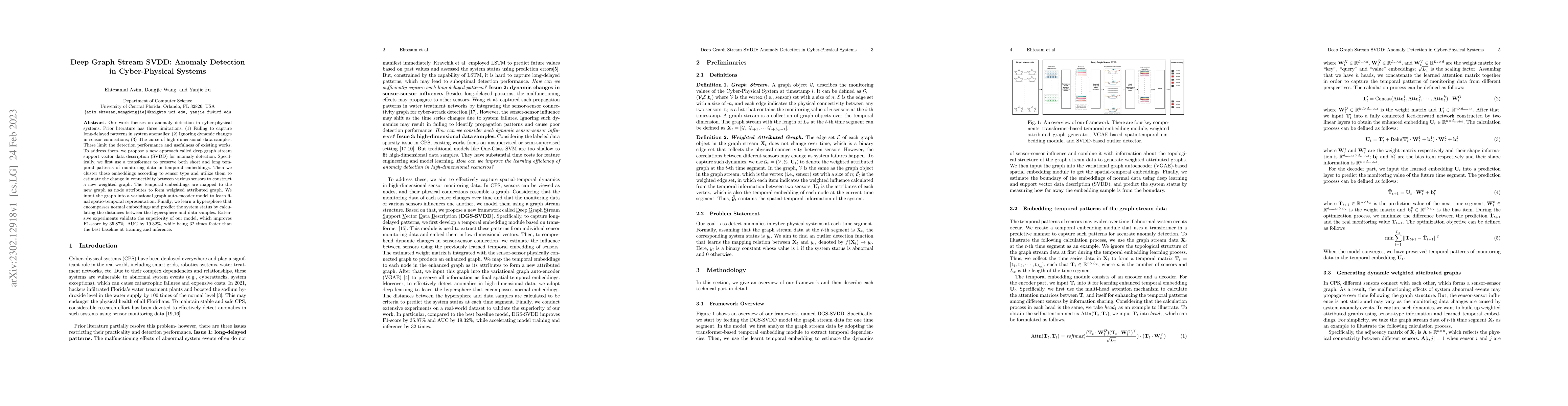
Our work focuses on anomaly detection in cyber-physical systems. Prior literature has three limitations: (1) Failing to capture long-delayed patterns in system anomalies; (2) Ignoring dynamic changes in sensor connections; (3) The curse of high-dimensional data samples. These limit the detection performance and usefulness of existing works. To address them, we propose a new approach called deep graph stream support vector data description (SVDD) for anomaly detection. Specifically, we first use a transformer to preserve both short and long temporal patterns of monitoring data in temporal embeddings. Then we cluster these embeddings according to sensor type and utilize them to estimate the change in connectivity between various sensors to construct a new weighted graph. The temporal embeddings are mapped to the new graph as node attributes to form weighted attributed graph. We input the graph into a variational graph auto-encoder model to learn final spatio-temporal representation. Finally, we learn a hypersphere that encompasses normal embeddings and predict the system status by calculating the distances between the hypersphere and data samples. Extensive experiments validate the superiority of our model, which improves F1-score by 35.87%, AUC by 19.32%, while being 32 times faster than the best baseline at training and inference.
AI Key Findings
Get AI-generated insights about this paper's methodology, results, significance, and more — available when analysis has been generated.
Discussion 0