This paper presents Bell-type tests for detecting nonclassicality and non-Gaussianity in single-mode fields using generalized quasiprobability functions. The tests optimize detection of non-Gaussian states through phase-space transformations and evaluate their robustness against decoherence and finite data limitations.
Abstract
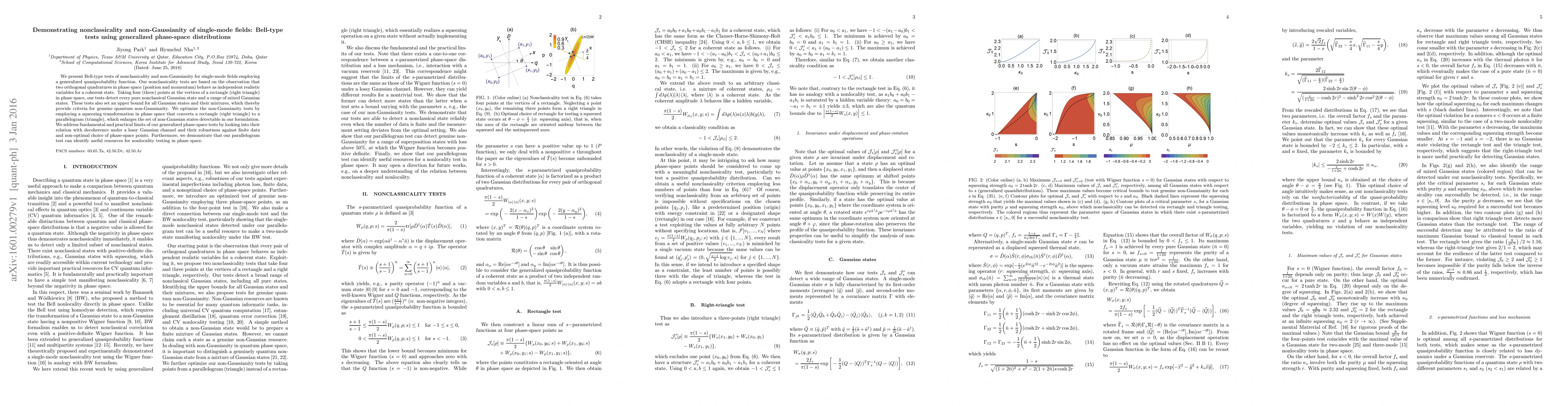
We present Bell-type tests of nonclassicality and non-Gaussianity for single-mode fields employing a generalized quasiprobability function. Our nonclassicality tests are based on the observation that two orthogonal quadratures in phase space (position and momentum) behave as independent realistic variables for a coherent state. Taking four (three) points at the vertices of a rectangle (right triangle) in phase space, our tests detect every pure nonclassical Gaussian state and a range of mixed Gaussian states. These tests also set an upper bound for all Gaussian states and their mixtures, which thereby provide criteria for genuine quantum non-Gaussianity. We optimize the non-Gaussianity tests by employing a squeezing transformation in phase space that converts a rectangle (right triangle) to a parallelogram (triangle), which enlarges the set of non-Gaussian states detectable in our formulation. We address fundamental and practical limits of our generalized phase-space tests by looking into their relation with decoherence under a lossy Gaussian channel and their robustness against finite data and nonoptimal choice of phase-space points. Furthermore, we demonstrate that our parallelogram test can identify useful resources for nonlocality testing in phase space.
AI Key Findings
Get AI-generated insights about this paper's methodology, results, significance, and more — available when analysis has been generated.
Discussion 0