Designing a Wayfinding Robot for People with Visual Impairments
This paper introduces an in-progress wayfinding robot designed to assist people with visual impairments in navigating unfamiliar indoor environments by autonomously planning a path based on user audio commands and real-time position data. The robot also provides periodic descriptions of surroundings to prevent disorientation, demonstrating feasibility in a public indoor setting.
Abstract
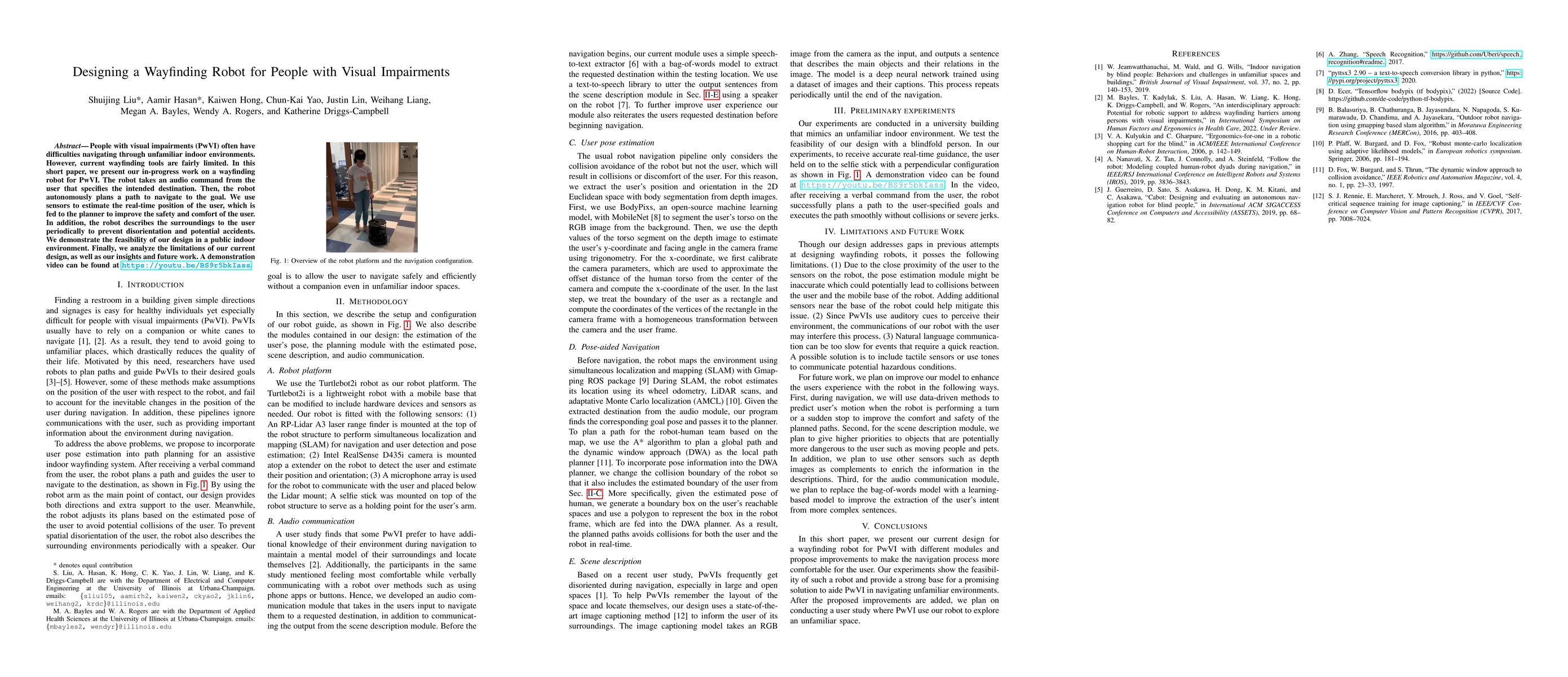
People with visual impairments (PwVI) often have difficulties navigating through unfamiliar indoor environments. However, current wayfinding tools are fairly limited. In this short paper, we present our in-progress work on a wayfinding robot for PwVI. The robot takes an audio command from the user that specifies the intended destination. Then, the robot autonomously plans a path to navigate to the goal. We use sensors to estimate the real-time position of the user, which is fed to the planner to improve the safety and comfort of the user. In addition, the robot describes the surroundings to the user periodically to prevent disorientation and potential accidents. We demonstrate the feasibility of our design in a public indoor environment. Finally, we analyze the limitations of our current design, as well as our insights and future work. A demonstration video can be found at https://youtu.be/BS9r5bkIass.
AI Key Findings
Get AI-generated insights about this paper's methodology, results, significance, and more — available when analysis has been generated.
Discussion 0