Detecting Flaring Structures in Sagittarius A* with (Sub)Millimeter VLBI
This paper investigates the use of (sub)millimeter VLBI to detect flaring structures near Sagittarius A*, the supermassive black hole at the Milky Way's center. The study finds that periodicity in flares can be identified using closure quantities, suggesting that (sub)millimeter VLBI will be crucial for probing the environment near the event horizon.
Abstract
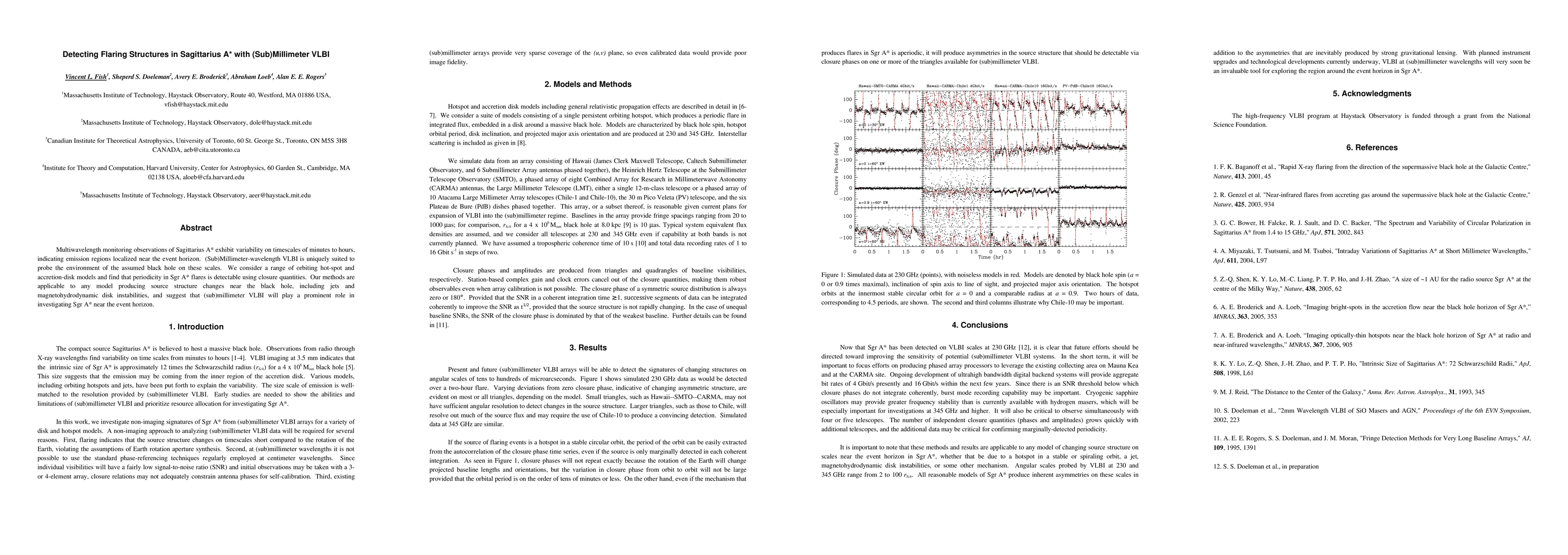
Multiwavelength monitoring observations of Sagittarius A* exhibit variability on timescales of minutes to hours, indicating emission regions localized near the event horizon. (Sub)Millimeter-wavelength VLBI is uniquely suited to probe the environment of the assumed black hole on these scales. We consider a range of orbiting hot-spot and accretion-disk models and find that periodicity in Sgr A* flares is detectable using closure quantities. Our methods are applicable to any model producing source structure changes near the black hole, including jets and magnetohydrodynamic disk instabilities, and suggest that (sub)millimeter VLBI will play a prominent role in investigating Sgr A* near the event horizon.
AI Key Findings
Get AI-generated insights about this paper's methodology, results, significance, and more — available when analysis has been generated.
Discussion 0