Detection Is Not Early Warning: Evaluating Token-Level Alarms on Language Model Failures
Abstract
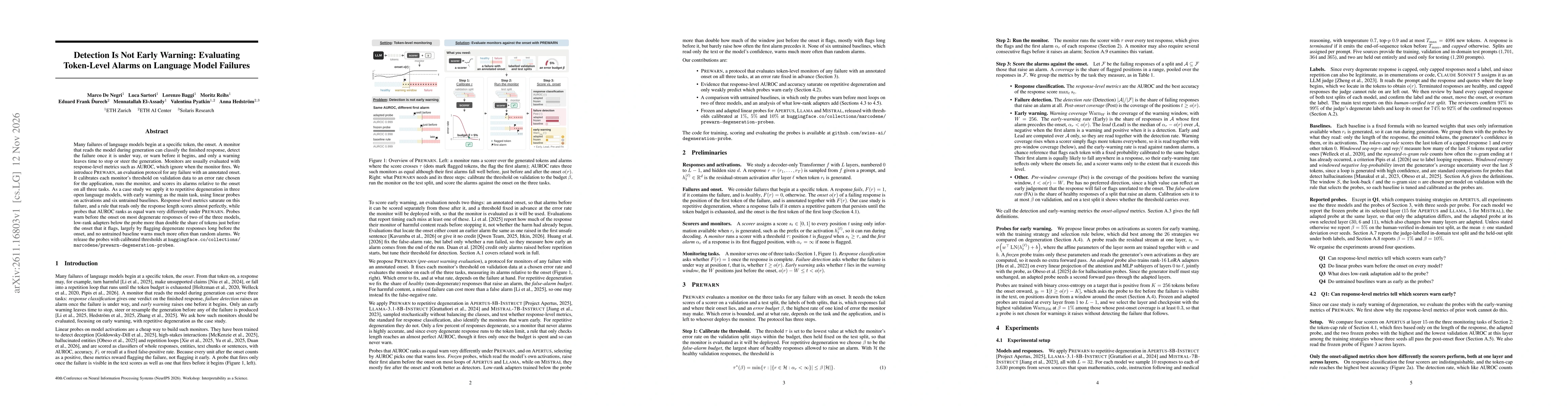
Many failures of language models begin at a specific token, the onset. A monitor that reads the model during generation can classify the finished response, detect the failure once it is under way, or warn before it begins, and only a warning leaves time to stop or steer the generation. Monitors are usually evaluated with response-level metrics such as AUROC, which ignore when the monitor fires. We introduce PREWARN, an evaluation protocol for any failure with an annotated onset. It calibrates each monitor's threshold on validation data to an error rate chosen for the application, runs the monitor, and scores its alarms relative to the onset on all three tasks. As a case study we apply it to repetitive degeneration in three open language models, with early warning as the main task, using linear probes on activations and six untrained baselines. Response-level metrics saturate on this failure, and a rule that reads only the response length scores almost perfectly, while probes that AUROC ranks as equal warn very differently under PREWARN. Probes warn before the onset on most degenerate responses of two of the three models, low-rank adapters below the probe more than double the share of tokens just before the onset that it flags, largely by flagging degenerate responses long before the onset, and no untrained baseline warns much more often than random alarms. We release the probes with calibrated thresholds at https://huggingface.co/collections/marcodene/prewarn-degeneration-probes
Analysis
AI-generated · verify against the original paper
Generated Jan 1, 0001ResultsWhat the authors found
- Response‑level metrics such as AUROC saturate on repetitive degeneration, while a simple rule based only on response length achieves near‑perfect AUROC.
- Linear probes that rank similarly by AUROC warn at very different times under PREWARN, with most probes flagging tokens before the onset in two of the three models.
- Low‑rank adapters trained below the probe more than double the share of tokens just before the onset that are flagged, largely by warning long before the onset.
- Untrained baselines do not warn significantly more often than random alarms.
LimitationsWhere the findings need caution
- The study focuses only on repetitive degeneration and three specific open‑source models, limiting generality to other failure modes.
- Evaluation requires an annotated onset for each failure, which may not be available for many real‑world errors.
MethodologyHow the work was done
The authors propose PREWARN, an evaluation protocol that calibrates monitor thresholds on validation data to a fixed error budget, runs the monitor on test data, and scores token-level alarms relative to annotated failure onsets for three tasks (response classification, failure detection, early warning). They apply this protocol to repetitive degeneration in three open‑source language models using linear probes on activations and six untrained baselines.
SignificanceWhy the work matters
PREWARN reveals that conventional response‑level evaluation can mask important differences in early‑warning capability, highlighting the need for token‑level timing metrics when designing monitors that can intervene before failures occur.
Technical contributionsWhat the work introduces
Introduction of the PREWARN protocol for calibrated, token‑level evaluation of monitors against annotated failure onsets, and a benchmark of linear probes and baselines for early warning of repetitive degeneration.
NoveltyHow it differs from prior work
The work demonstrates that early‑warning performance can diverge dramatically from traditional AUROC scores, and provides the first systematic protocol to assess and compare token‑level alarm timing.
Future workQuestions that remain
- Extend PREWARN to other types of language model failures such as harmful content or hallucinations.
- Develop monitoring methods that can operate without explicit onset annotations.
Discussion 0