Detector Operating Behavior Inference via Data-Space Sampling
Abstract
A detector scores candidate detections, but the recall and false alarms at a given confidence threshold depend on the input distribution. We introduce Detector Operating Behavior Inference (DOBI), a second-level inference task: estimating a fixed detector's threshold-dependent, distribution-level operating response from the internal evidence of a single unlabeled image. DOBI treats the detector's threshold response, i.e. recall, false positives, and precision across thresholds, as a latent behavioral state under the current data condition. Controlled data-space sampling probes this state space offline, and a lightweight monitor learns the inverse map from one image to this state, whose single functional output supports multiple operating policies. In a controlled proof of concept with a fixed YOLOv10-Nano person detector and COCO-derived degradations, predicted PR behavior reduces mean absolute deviation from 0.128 for an image-independent mean-behavior prior to 0.054, and predicted functional distances track empirical regime distances (Spearman 0.96). From one unlabeled image, the inferred behavior selects operating points as well as a non-deployable lookup that knows the true regime (macro-regime $F_1$ 0.6604 for both, versus 0.6407 under pristine calibration; oracle 0.6620). On this discrete benchmark, regime-supervised curve lookups are strong controls. Pre-specified continuous and compositional probing shows where functional inference matters: on unseen combinations, the functional decoder has a lower mean curve error than a template lookup, increasingly with distance from the training conditions, whereas the lookup is more accurate for interpolation. These results establish the feasibility of single-image inference of distribution-level detector behavior over the probed conditions. Source code is available at https://github.com/beckerio/dobi
Analysis
AI-generated · verify against the original paper
Generated Jan 1, 0001ResultsWhat the authors found
- Mean absolute deviation of predicted PR behavior drops from 0.128 (image‑independent prior) to 0.054.
- Predicted functional distances correlate with empirical regime distances (Spearman ρ = 0.96).
- Macro‑F1 of 0.6604 achieved using the inferred behavior versus 0.6407 with pristine calibration and 0.6620 for an oracle.
- Functional decoder yields lower mean curve error than template lookup on unseen condition combinations, with the advantage growing with distance from training conditions.
- Soft lookup (regime‑supervised) provides the best deployable performance, improving F1 by +0.005 (vehicles) and +0.006 (persons) over a fixed threshold.
LimitationsWhere the findings need caution
- Metadata for regimes is coarse (per‑image categories without intensity), limiting granularity of condition modeling.
- Regime definitions were chosen post‑hoc after exploratory analysis, and only a few qualified regimes exist for persons.
- Scene composition confounds the interpretation of regime effects, especially for person detections.
- Monitors are trained and evaluated within a single domain; cross‑domain transferability is not demonstrated.
MethodologyHow the work was done
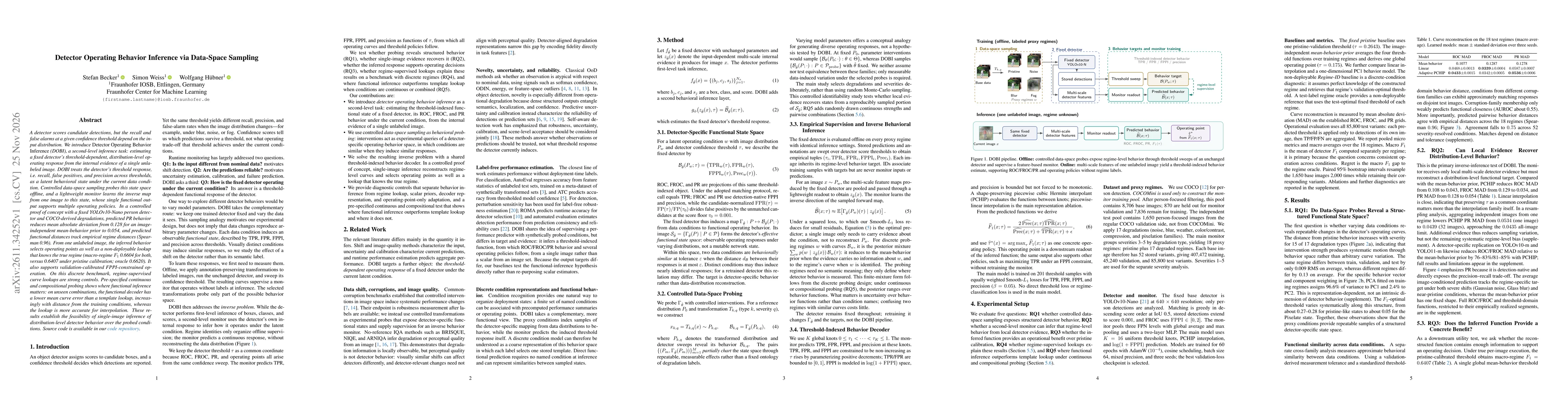
The authors apply controlled data-space sampling by applying annotation-preserving transformations to labeled images, run a fixed YOLOv10-Nano detector across confidence thresholds, and collect the resulting precision-recall curves as supervision. A lightweight monitor (decoder) is then trained to map the internal evidence from a single unlabeled image to the latent detector operating state (TPR, FPR, FPPI, precision) as a function of threshold.
SignificanceWhy the work matters
DOBI demonstrates that a detector’s full threshold‑dependent operating characteristics can be inferred from a single unlabeled image, enabling label‑free runtime calibration, adaptive operating‑point selection, and more reliable deployment under distribution shift.
Technical contributionsWhat the work introduces
Introduces Detector Operating Behavior Inference (DOBI) as a second‑level task, proposes controlled data‑space sampling to probe detector behavior, and provides a shared threshold‑indexed behavior decoder that reconstructs full PR/FROC curves from a single image.
NoveltyHow it differs from prior work
First work to infer a detector’s distribution‑level, threshold‑dependent performance curves from the internal evidence of a single unlabeled image, rather than aggregating over image sets or relying on external quality metrics.
Discussion 0