Deviation identity for linear differential operators and its application to obstacle problems
Abstract
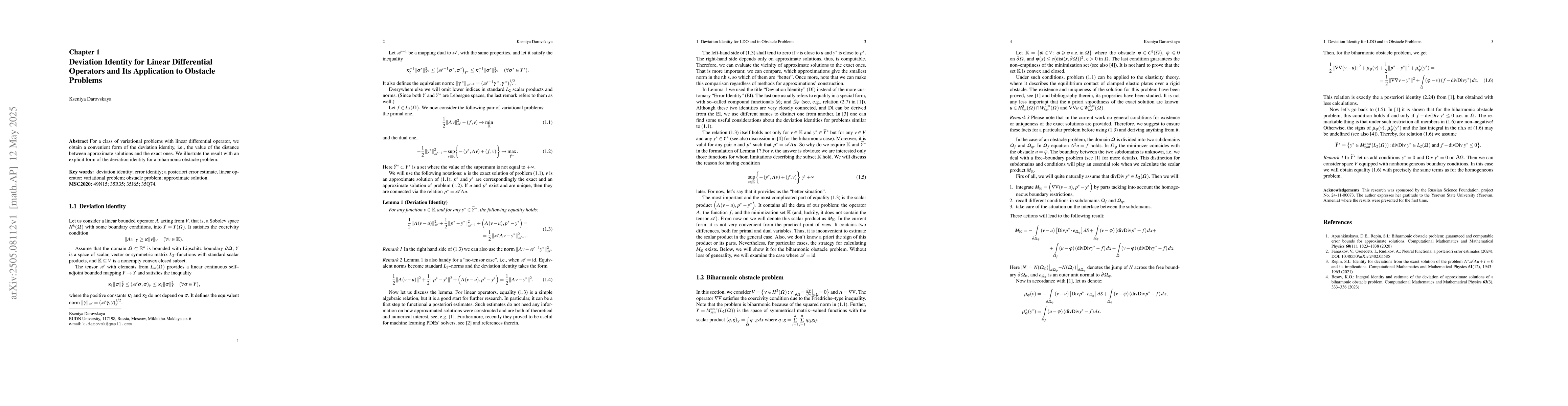
For a class of variational problems with linear differential operator, we obtain a convenient form of the deviation identity, i.e., the value of the distance between approximated solutions and the exact ones. We illustrate the result with an explicit form of the deviation identity for a biharmonic obstacle problem.
Analysis
AI-generated · verify against the original paper
Generated Jun 8, 2025ResultsWhat the authors found
- Obtaining a deviation identity for a class of variational problems with linear differential operators.
- Providing an explicit form of the deviation identity for the biharmonic obstacle problem.
LimitationsWhere the findings need caution
- The study focuses on a specific class of variational problems with linear differential operators, so its applicability to nonlinear or higher-order problems may be limited.
- The explicit form of the deviation identity is given only for the biharmonic obstacle problem, restricting the generalization of findings to other specific cases without further development.
MethodologyHow the work was done
The research derives a convenient form of the deviation identity for variational problems involving linear differential operators, specifically exemplifying it with a biharmonic obstacle problem.
SignificanceWhy the work matters
This work is significant as it offers a useful tool for analyzing the distance between approximated and exact solutions in variational problems, which can be applied to obstacle problems and similar scenarios in mathematical analysis.
Technical contributionsWhat the work introduces
The paper presents a novel form of the deviation identity tailored for variational problems governed by linear differential operators, with a concrete example for the biharmonic obstacle problem.
NoveltyHow it differs from prior work
This research contributes novelly by providing a convenient and explicit deviation identity form specifically for variational problems with linear differential operators, offering insights applicable to obstacle problems.
Future workQuestions that remain
- Extending the deviation identity to a broader class of variational problems, including nonlinear and higher-order differential operators.
- Investigating the applicability of the obtained identity to other types of obstacle problems or related mathematical models.
Discussion 0