DiCT: Teaching X-ray Vision-Language Models to Reason via Imagining CT
Abstract
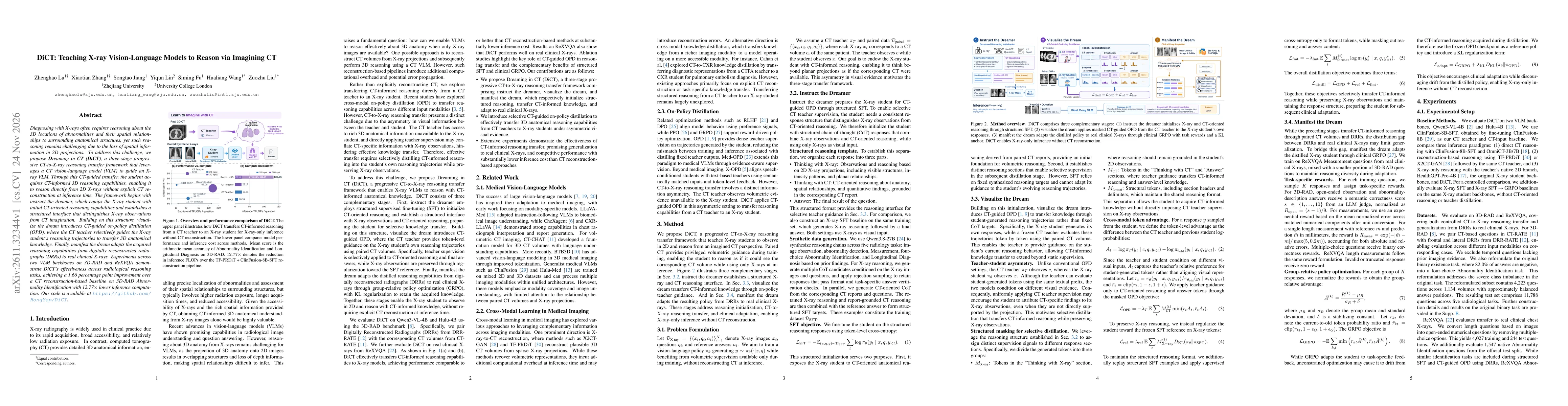
Diagnosing with X-rays often requires reasoning about the 3D locations of abnormalities and their spatial relationships to surrounding anatomical structures, yet such reasoning remains challenging due to the loss of spatial information in 2D projections. To address this challenge, we propose Dreaming in CT (DiCT), a three-stage progressive CT-to-X-ray reasoning transfer framework that leverages a CT vision-language model (VLM) to guide an X-ray VLM. Through this CT-guided transfer, the student acquires CT-informed 3D reasoning capabilities, enabling it to reason directly from 2D X-rays without explicit CT reconstruction at inference time. The framework begins with instruct the dreamer, which equips the X-ray student with initial CT-oriented reasoning capabilities and establishes a structured interface that distinguishes X-ray observations from CT imagination. Building on this structure, visualize the dream introduces CT-guided on-policy distillation (OPD), where the CT teacher selectively guides the X-ray student's reasoning trajectories to transfer 3D anatomical knowledge. Finally, manifest the dream adapts the acquired reasoning capabilities from digitally reconstructed radiographs (DRRs) to real clinical X-rays. Experiments across two VLM backbones on 3D-RAD and ReXVQA demonstrate DiCT's effectiveness across radiological reasoning tasks, achieving a 1.66 percentage point improvement over a CT reconstruction-based baseline on 3D-RAD Abnormality Identification with 12.77$\times$ lower inference computation. Our code is available at https://github.com/HongYep/DiCT.
Analysis
AI-generated · verify against the original paper
Generated Jan 1, 0001ResultsWhat the authors found
- DiCT achieves a 1.66 percentage point improvement over a CT reconstruction-based baseline on 3D‑RAD Abnormality Identification.
- The method reduces inference computation by 12.77× compared to reconstruction pipelines.
- Experiments on ReXVQA show that DiCT generalizes well to real clinical X‑rays, matching or surpassing reconstruction‑based approaches.
MethodologyHow the work was done
DiCT employs a three-stage progressive CT-to-X-ray reasoning transfer framework: (1) Instruct the Dreamer uses structured supervised fine-tuning to give the X-ray student initial CT-oriented reasoning and a structured interface; (2) Visualize the Dream introduces CT-guided on-policy distillation where a frozen CT teacher selectively guides the student's reasoning trajectories; (3) Manifest the Dream adapts the distilled reasoning from digitally reconstructed radiographs to real clinical X-rays via group-relative policy optimization with KL regularization.
SignificanceWhy the work matters
The framework enables X‑ray vision‑language models to perform 3D anatomical reasoning without explicit CT reconstruction, lowering radiation exposure, acquisition time, and computational cost while preserving diagnostic accuracy.
Technical contributionsWhat the work introduces
Introduction of CT‑guided on‑policy distillation and a progressive three‑stage transfer pipeline that combines structured SFT, selective knowledge distillation, and policy optimization to endow X‑ray models with CT‑informed 3D reasoning.
NoveltyHow it differs from prior work
First approach to transfer CT‑informed 3D reasoning directly to X‑ray vision‑language models, eliminating the need for CT reconstruction at inference time.
Discussion 0