Difference-Set Weyl Channels: Exact Capacity, Optimizer Bifurcation, and Scalable Entanglement Separation
The paper analyzes a class of Weyl-operator quantum channels in odd dimensions, showing when capacity and entanglement properties can be exactly characterized using difference-set structures and phase-space decompositions. It reveals precise conditions under which capacity, output purity, and entanglement behave predictably across many uses, including scenarios with fixed shift-phase noise and balanced interpolation, and it identifies regimes where Wigner positivity coexists with channel entanglement and scalable advantages.
Abstract
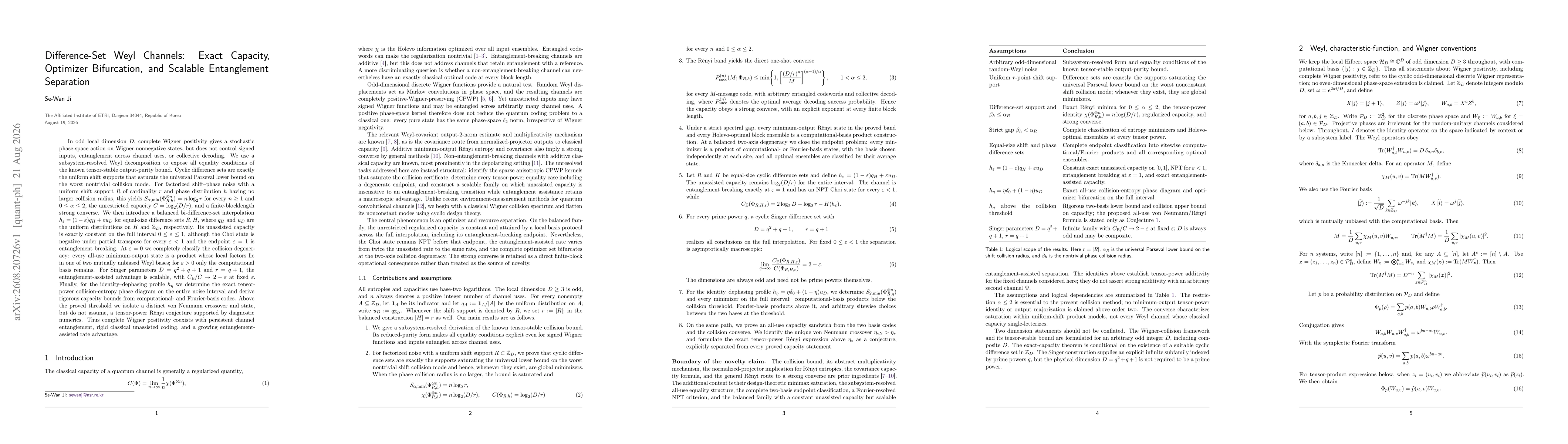
In odd local dimension $D$, complete Wigner positivity yields stochastic phase-space dynamics on Wigner-nonnegative states but does not control signed inputs, entanglement across channel uses, or collective decoding. Using a subsystem-resolved Weyl decomposition, we characterize the equality conditions of the tensor-stable output-purity bound. Cyclic difference sets are precisely the uniform shift supports saturating the universal Parseval lower bound on the worst nontrivial collision mode. For factorized shift--phase noise with shift support $R$, $|R|=r$, and phase distribution $h$ of no larger collision radius, we obtain $S_{α,\min}(Φ_{R,h}^{\otimes n})=n\log_2 r$ for all $n\ge1$ and $0\leα\le2$, the unrestricted capacity $C=\log_2(D/r)$, and a finite-blocklength strong converse. For a balanced bi-difference-set interpolation $h_\varepsilon=(1-\varepsilon)q_H+\varepsilon u_D$, the unassisted capacity is constant for $0\le\varepsilon\le1$, while the Choi state is NPT for every $\varepsilon<1$ and becomes entanglement breaking at $\varepsilon=1$. At $\varepsilon=0$, all tensor-power minimum-output states are products with local factors in one of two mutually unbiased Weyl bases; for $\varepsilon>0$, only the computational basis remains. For Singer parameters $D=q^2+q+1$ and $r=q+1$, $C_{\mathrm E}/C\to2-\varepsilon$. Finally, for an identity--dephasing profile we determine the exact tensor-power collision-entropy phase diagram, derive rigorous capacity bounds, and isolate a distinct von Neumann crossover, with a tensor-power R'enyi conjecture supported by numerics. Thus complete Wigner positivity can coexist with persistent channel entanglement and a scalable entanglement-assisted advantage.
Analysis
AI-generated · verify against the original paper
Generated Aug 25, 2026ResultsWhat the authors found
- For factorized shift–phase noise with shift support R of size r and phase distribution h with bounded collision radius, Sα,min(Φ⊗nR,h)=n log2 r for all n≥1 and 0≤α≤2, yielding C(ΦR,h)=log2(D/r) and a finite-blocklength strong converse.
- Balanced bi-difference-set interpolation hε = (1−ε) qH + ε uD yields unassisted capacity constant over 0≤ε≤1, while the Choi state is NPT for ε<1 and entanglement breaking at ε=1; at ε=0 all tensor-power minimum-output states are product with local factors in two MUB Weyl bases; for ε>0 only the computational basis remains.
- For Singer parameters D=q2+q+1 and r=q+1, entanglement-assisted capacity scales as CE/C → 2−ε, indicating growing advantage with ε.
- An identity–dephasing profile yields an exact tensor-power collision-entropy phase diagram, rigorous capacity bounds, and a distinct von Neumann crossover, with numerical support for a tensor-power Rényi conjecture.
LimitationsWhere the findings need caution
- Results rely on idealized difference-set and phase-noise models; real physical channels may only approximate these structures.
- Some conclusions are supported by numerics and conjectures (e.g., tensor-power Rényi conjecture) that require further analytical proof.
- Finite-dimensional diagnostics are provided, with extrapolation to general dimensions not fully established.
MethodologyHow the work was done
The authors perform a subsystem-resolved Weyl decomposition to analyze difference-set Weyl channels, derive equality conditions for tensor-stable output-purity bounds, and employ cyclic difference sets to saturate Parseval bounds; they then compute exact capacities, strong converse results, and phase diagrams under varied noise models including shift–phase noise and identity–dephasing profiles, with numerical diagnostics to support conjectures.
SignificanceWhy the work matters
Demonstrates that complete Wigner positivity can co-exist with persistent channel entanglement and scalable entanglement-assisted advantages, revealing structural regimes where unassisted capacity is insensitive to entanglement transitions and where optimal encodings align with cyclic difference-set structures.
Technical contributionsWhat the work introduces
A subsystem-resolved Weyl-decomposition framework that explicitizes equality conditions of tensor-stable output-purity, identifies cyclic difference sets as saturating uniform Parseval bounds, and derives exact capacity, strong converse, and phase-diagram results for a family of Weyl channels with scalable entanglement advantages.
NoveltyHow it differs from prior work
Introduces a unified treatment of difference-set Weyl channels linking combinatorial design (cyclic difference sets) with quantum channel capacity, revealing optimizer bifurcation points and a robust regime where unassisted capacity remains fixed while entanglement assistance grows.
Future workQuestions that remain
- Prove the tensor-power Rényi conjecture analytically and extend phase-diagram methodology to broader noise families.
- Investigate experimental implementations of difference-set Weyl channels to validate capacity and bifurcation predictions.
- Explore deeper connections between cyclic designs and optimal coding strategies for entanglement-assisted communication across operator algebras.
- Generalize the balanced bi-difference-set interpolation to non-uniform and asymmetric difference sets to assess robustness of the unassisted capacity.
Discussion 0