Differential Flatness of Nonlinear Consensus Networks: A Graph-Theoretic Perspective
Abstract
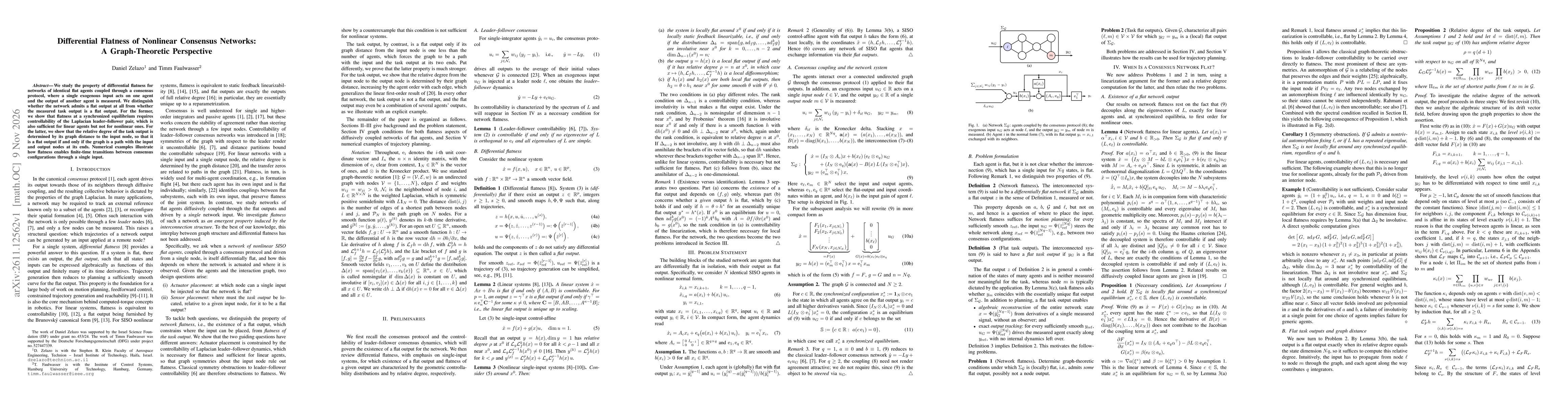
We study the property of differential flatness for networks of identical flat agents coupled through a consensus protocol, where a single exogenous input acts on one agent and the output of another agent is measured. We distinguish whether the network admits a flat output at all from whether the measured task output is a flat output. For the former, we show that flatness at a synchronized equilibrium requires controllability of the Laplacian leader--follower pair, which is also sufficient for linear agents but not for nonlinear ones. For the latter, we show that the relative degree of the task output is determined by its graph distance to the input node, so that it is a flat output if and only if the graph is a path with the input and output nodes at its ends. Numerical examples illustrate how flatness enables finite-time transitions between consensus configurations through a single input.
Analysis
AI-generated · verify against the original paper
Generated Jan 1, 0001ResultsWhat the authors found
- Flatness at a synchronized equilibrium requires controllability of the Laplacian leader–follower pair, which is sufficient for linear agents but not for nonlinear agents.
- The task output is a flat output if and only if the underlying graph is a path with the input and output nodes at its ends.
- The relative degree of the task output equals the graph distance from the input node plus one.
- Numerical examples demonstrate finite-time consensus transitions using a single input and illustrate hidden flat outputs in non‑path graphs.
LimitationsWhere the findings need caution
- The controllability condition is not sufficient for flatness of nonlinear consensus networks.
- Flat task outputs occur only for the restrictive case of path graphs with end‑node placement.
- Scalability for nonlinear agents is limited as required input magnitude grows rapidly with network size.
MethodologyHow the work was done
The paper employs graph-theoretic analysis combined with differential flatness theory to derive controllability conditions for consensus networks, proves flatness results using Laplacian leader–follower controllability, and validates findings with numerical simulations of trajectory planning on path graphs.
SignificanceWhy the work matters
The work reveals a fundamental link between network topology and differential flatness, enabling systematic trajectory planning for multi‑agent systems with minimal actuation.
Technical contributionsWhat the work introduces
Derivation of necessary and sufficient conditions linking Laplacian controllability to network flatness, identification of graph‑distance based relative degree, and construction of global flatness maps (Φ, Ψ) for consensus networks.
NoveltyHow it differs from prior work
First study to connect differential flatness of consensus networks with graph structure, establishing path‑graph criteria for flat task outputs and highlighting differences between linear and nonlinear agent dynamics.
Future workQuestions that remain
- Develop a graph‑theoretic characterization of network flatness for generic nonlinear agents.
- Extend trajectory planning to incorporate input constraints and multiple input/output nodes.
- Investigate flatness properties for directed graphs and nonlinear diffusive couplings.
- Explore the relationship between flat inputs and the presented flatness conditions.
Discussion 0