Disambiguating 2D-3D Correspondences in Gaussian Splatting-based Feature Fields for Visual Localization
Abstract
While Gaussian Splatting-based Feature Fields (GSFFs) have shown promise for visual localization, this paper highlights that photometrically optimized GSFFs are inherently not suitable for 2D-3D matching. The volumetric extent of each Gaussian induces many-to-one pixel-to-point mappings that destabilize PnP-based pose estimation, while photometric optimization gives rise to superfluous Gaussians devoid of multi-view consistency. To address these issues, we propose SplitGS-Loc, a GSFFs construction framework for localization, which disambiguates 2D-3D correspondences by exploiting Gaussian attributes. Our key design, Mixture-of-Gaussians-based splitting, decomposes each Gaussian into smaller Gaussians, replacing ambiguous many-to-one with precise one-to-one correspondences. In parallel, we exploit composition weights from GS rasterization to select Gaussians that significantly and consistently contribute across multiple views and aggregate discriminative features through strong pixel-Gaussian associations. The resulting compact yet discriminative feature fields enable stable PnP convergence, achieving competitive performance on localization benchmarks. Extensive experiments validate that SplitGS-Loc extends the utility of photometric GSFFs to accurate and efficient localization by exploiting Gaussian attributes, without per-scene training for feature fields or iterative pose refinement. The code is available at: https://github.com/misoleekr/SplitGS-Loc.
Analysis
AI-generated · verify against the original paper
Generated Jan 1, 0001ResultsWhat the authors found
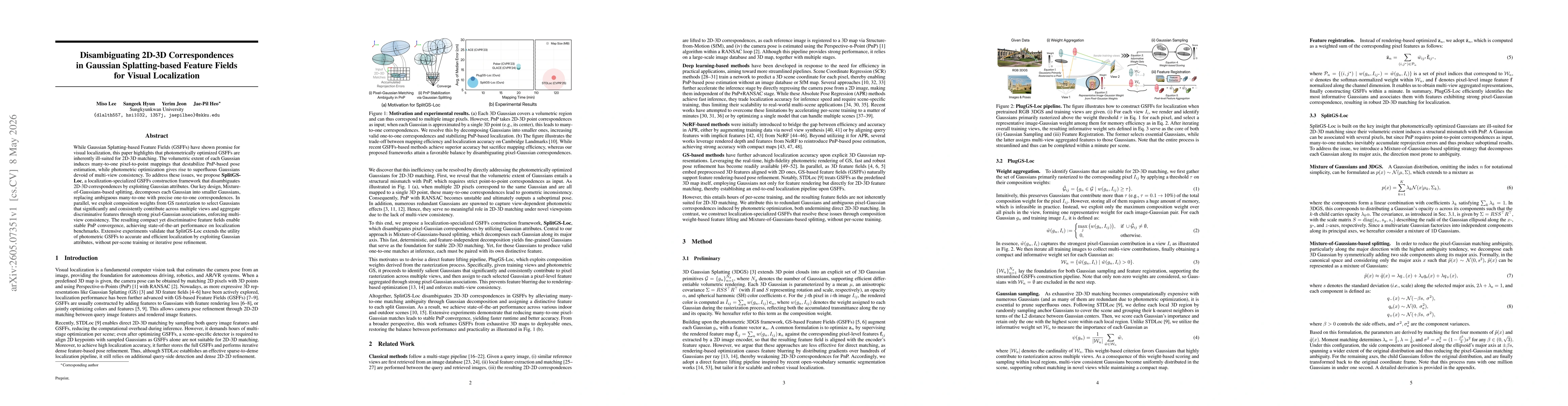
- SplitGS-Loc reduces mapping time to 7 minutes while achieving comparable median translation/rotation errors (≈19.5 cm/0.27°) to the 2‑hour STDLoc pipeline.
- The method stabilizes PnP convergence by eliminating many‑to‑one pixel‑Gaussian correspondences, leading to accurate pose estimates across indoor and outdoor scenes.
- SplitGS-Loc outperforms STDLoc under varying appearance conditions (summer, winter, evening) without any adaptation.
- When combined with feature‑rendering refinement or GS‑CPR, SplitGS-Loc further improves localization accuracy, albeit at the cost of increased map size.
LimitationsWhere the findings need caution
- Pose refinement still requires storing the full original GSFF, which significantly increases map size.
- Performance can degrade on certain datasets (e.g., GS‑CPR on Cambridge Landmarks) due to resolution mismatches between refinement methods and image data.
- The approach relies on a fixed composition‑weight threshold, which, while generally robust, may need tuning for new scenes.
MethodologyHow the work was done
We propose SplitGS-Loc, a framework that constructs Gaussian‑splatting‑based feature fields for visual localization by decomposing each volumetric Gaussian into smaller Gaussians via a Mixture‑of‑Gaussians‑based splitting along its major axis, and selecting salient Gaussians using composition weights from rasterization to assign distinct pixel‑level features, thereby creating compact yet discriminative feature maps for stable 2D‑3D matching and PnP pose estimation.
SignificanceWhy the work matters
By disambiguating 2D‑3D correspondences through Gaussian splitting and weight‑based selection, SplitGS-Loc extends photometric Gaussian splatting to efficient and accurate visual localization without per‑scene training or iterative pose refinement, bridging the gap between high‑accuracy mapping and practical deployment.
Technical contributionsWhat the work introduces
The paper introduces the SplitGS-Loc framework, including a deterministic Mixture‑of‑Gaussians splitting algorithm, a composition‑weight based Gaussian selection mechanism, and the PlugGS-Loc pipeline for direct feature lifting, collectively enabling compact, discriminative feature fields for stable PnP‑based localization.
NoveltyHow it differs from prior work
First work to resolve many‑to‑one 2D‑3D matching ambiguities in Gaussian‑splatting feature fields by decomposing Gaussians into smaller units and leveraging rasterization weights to construct reliable one‑to‑one correspondences.
Discussion 0