Distilling Reasoning Traces into Advisory Prompts for Software Engineering Tasks
Abstract
Language models are widely used for generating and otherwise processing code (e.g., identifying code hallucinations, possible inputs, or predicting outputs); however, LLMs can make mistakes, which can be serious. One key issue is that models are trained on (still) largely human-written, and thus imperfect, code; it's not easy to find sufficiently large code corpora that are entirely free of bugs. Thus, other inference-time ways of reducing LLM errors, without additional training, are desirable. "Reasoning" or "thinking" modes, exposed as a togglable feature by hybrid reasoning models, do reduce errors; however, reasoning consumes additional resources. This paper asks if better performance can be achieved without always incurring the cost of reasoning. Human students of programming learn to avoid mistakes by (a) identifying them, (b) reflecting upon the cognitive lapses that led to them (essentially, "thinking through" the errors), (c) inferring general rules or lessons from these reflections, and (d) internalizing these lessons into rules. In tutorial sessions with an instructor, this is a common Socratic interaction. Examples of such internalizable rules might include the nugget "Before coding, restate the requirements to clarify them." Inspired by this process, this paper describes an approach where we first identify examples in which "thinking mode" in a (low-resource) LLM avoids errors. These errors, and their avoidance via "thinking" in the same LLM, are then examined by a bigger LLM to generate summary explanations; these are then summarized by a large LLM into brief advisory prompts. This approach works on many modest-sized models; in some cases, the "advisory prompts" thus learned can also be gainfully transferred to other models. We also present investigations into the nature of coding errors that language models make, and a characterization of when this approach can be helpful.
Analysis
AI-generated · verify against the original paper
Generated Jan 1, 0001ResultsWhat the authors found
- Advisory prompts distilled from thinking‑mode deltas improve held‑out performance on reasoning‑intensive software engineering tasks while using fewer tokens than full reasoning.
- The distilled prompts can be transferred to other modestly sized models, yielding accuracy gains on those models as well.
- Error analysis shows that many coding mistakes are shared across models, enabling a single model’s advisory prompts to benefit another model.
LimitationsWhere the findings need caution
- The approach relies on the availability of a larger teacher model to generate summaries, which may not be feasible in all settings.
- Effectiveness is evaluated only on a set of five software‑engineering task families and four modestly sized hybrid models, limiting generalizability.
MethodologyHow the work was done
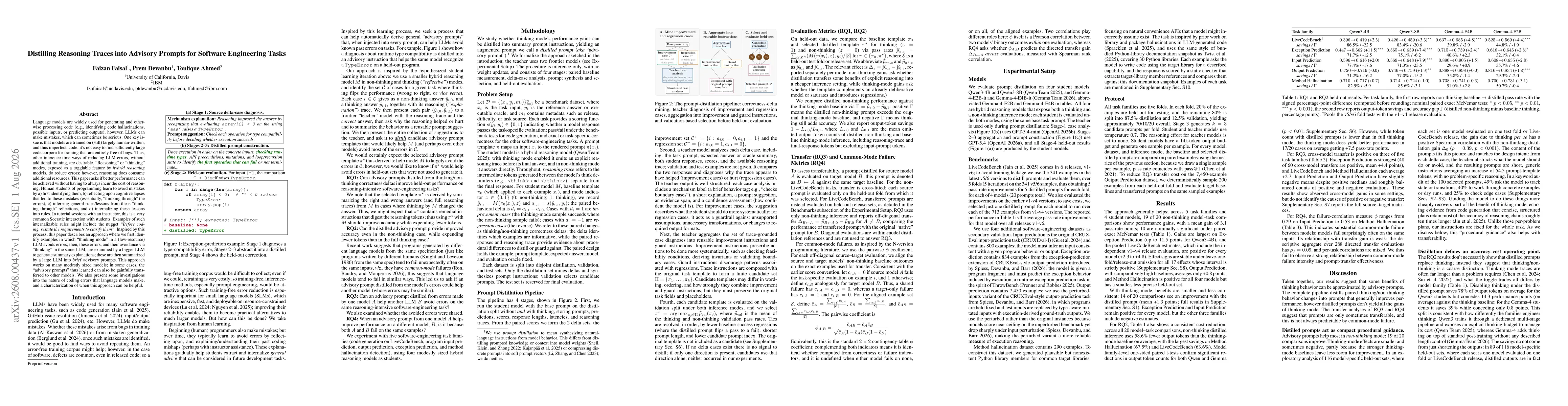
The authors use a four-stage inference-only pipeline: (1) paired baseline measurement with a low‑resource hybrid reasoning model in non‑thinking and thinking modes to collect predictions, scores, and reasoning traces; (2) delta‑case analysis to identify examples where thinking improves or harms performance; (3) prompt synthesis where a larger “teacher” model summarizes the reasoning traces and correct/incorrect outcomes into candidate advisory prompt templates; (4) selection of distilled advisory prompts and held‑out evaluation on separate test sets, also testing cross‑model transfer.
SignificanceWhy the work matters
The work demonstrates a training‑free, inference‑time method to capture the benefits of reasoning traces as lightweight prompts, enhancing reliability of small language models for software tasks and reducing computational cost.
Technical contributionsWhat the work introduces
A novel inference‑only prompt distillation pipeline that converts reasoning‑mode performance deltas into concise advisory prompts, enabling small models to reap reasoning benefits without incurring its computational overhead.
NoveltyHow it differs from prior work
First to systematically distill reasoning traces from low‑resource models into transferable advisory prompts, bridging human‑like reflective learning with automated prompt engineering for software engineering tasks.
Future workQuestions that remain
- Investigate broader sets of tasks and larger model families to assess the scalability of advisory prompt transfer.
- Explore automated methods for selecting the most informative delta cases without a teacher model.
Discussion 0