Distributionally Robust Mixture-of-Experts Training
Abstract
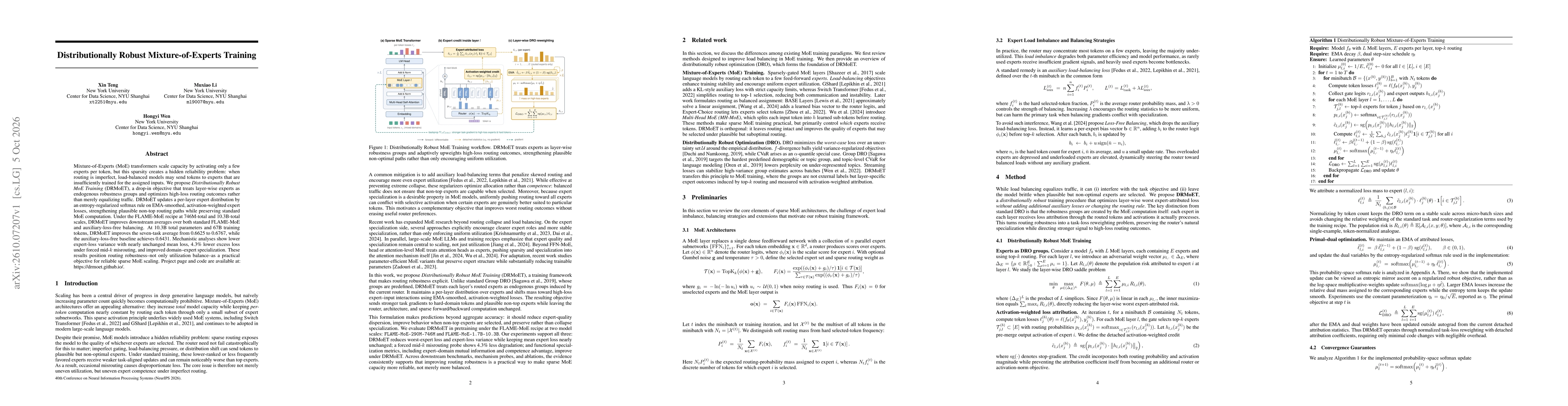
Mixture-of-Experts (MoE) transformers scale capacity by activating only a few experts per token, but this sparsity creates a hidden reliability problem: when routing is imperfect, load-balanced models may send tokens to experts that are insufficiently trained for the assigned inputs. We propose Distributionally Robust MoE Training (DRMoET), a drop-in objective that treats layer-wise experts as endogenous robustness groups and optimizes high-loss routing outcomes rather than merely equalizing traffic. DRMoET updates a per-layer expert distribution by an entropy-regularized softmax rule on EMA-smoothed, activation-weighted expert losses, strengthening plausible non-top routing paths while preserving standard MoE computation. Under the FLAME-MoE recipe at 746M-total and 10.3B-total scales, DRMoET improves downstream averages over both standard FLAME-MoE and auxiliary-loss-free balancing. At 10.3B total parameters and 67B training tokens, DRMoET improves the seven-task average from 0.6625 to 0.6767, while the auxiliary-loss-free baseline achieves 0.6431. Mechanistic analyses show lower expert-loss variance with nearly unchanged mean loss, 4.3% lower excess loss under forced mid-$k$ misrouting, and improved domain-expert specialization. These results position routing robustness-not only utilization balance-as a practical objective for reliable sparse MoE scaling. Project page and code are available at: https://drmoet.github.io/.
Analysis
AI-generated · verify against the original paper
Generated Jan 1, 0001ResultsWhat the authors found
- At 10.3B parameters and 67B tokens, DRMoET raises the seven‑task average from 0.6625 to 0.6767, outperforming the auxiliary‑loss‑free baseline (0.6431).
- Mechanistic analyses show lower expert‑loss variance with nearly unchanged mean loss.
- A forced mid‑k misrouting probe exhibits 4.3% less excess loss under DRMoET.
- Domain‑expert specialization metrics, including expert–domain mutual information and competence advantage, improve under DRMoET.
MethodologyHow the work was done
DRMoET introduces a drop-in training objective that treats layer-wise experts as endogenous robustness groups and updates a per-layer expert distribution using an entropy-regularized softmax on EMA‑smoothed, activation‑weighted expert losses, thereby upweighting high‑loss routing outcomes while keeping standard MoE computation unchanged.
SignificanceWhy the work matters
The work demonstrates that improving routing robustness, not merely utilization balance, is a practical and effective objective for reliable scaling of sparse Mixture‑of‑Experts models.
Technical contributionsWhat the work introduces
A distributionally robust training framework that adaptively reweights expert losses via an entropy‑regularized softmax rule, strengthening plausible non‑top routing paths without altering the router, architecture, or sparse forward/backward computation.
NoveltyHow it differs from prior work
Optimizing high‑loss routing outcomes rather than solely equalizing traffic, treating experts as endogenous robustness groups within a distributionally robust optimization setting.
Discussion 0