Does Cumulative XUV Unify the Neptunian Desert?
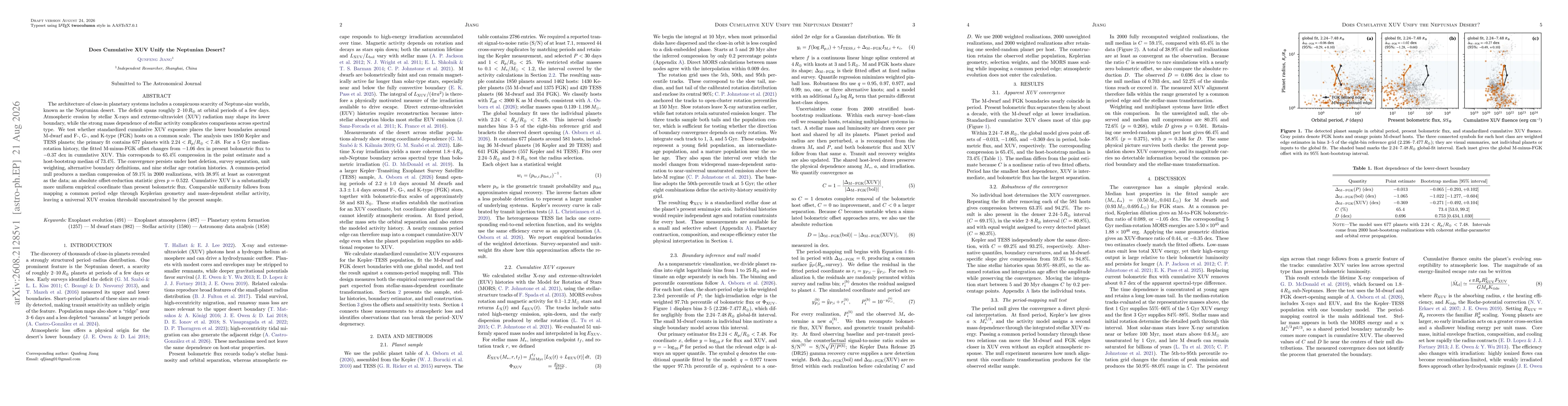
The study tests whether replacing stellar bolometric flux with cumulative XUV exposure unifies the lower edge of the Neptunian desert across different star types. Using 1850 Kepler/TESS planets, they find that cumulative XUV substantially compresses the FGK–M boundary, making an XUV-based erosion threshold a more universal predictor for Neptune-size planets than present bolometric flux.
Abstract
The architecture of close-in planetary systems includes a conspicuous scarcity of Neptune-size worlds, known as the Neptunian desert. The deficit spans roughly $2$--$10\,R_{\oplus}$ at orbital periods of a few days. Atmospheric erosion by stellar X-rays and extreme-ultraviolet (XUV) radiation may shape its lower boundary, while the strong mass dependence of stellar activity complicates comparisons across spectral type. We test whether standardized cumulative XUV exposure places the lower boundaries around M-dwarf and F-, G-, and K-type (FGK) hosts on a common scale. The analysis uses 1850 Kepler and TESS planets; the primary fit contains 677 planets with $2.24 < R_p/R_{\oplus} < 7.48$. For a 5 Gyr median-rotation history, the fitted M-minus-FGK offset changes from $-1.06$ dex in present bolometric flux to $-0.37$ dex in cumulative XUV. This corresponds to $65.4\%$ compression in the point estimate and a host-bootstrap median of $73.4\%$. The convergence persists under host deletion, survey separation, unit weighting, alternative boundary definitions, and nine stellar age--rotation histories. A common-period null produces a median compression of $59.1\%$ in 2000 realizations, with $38.9\%$ at least as convergent as the data; an absolute offset-reduction statistic gives $p=0.522$. Cumulative XUV is a substantially more uniform empirical coordinate than present bolometric flux. Comparable uniformity follows from mapping a common period edge through Keplerian geometry and mass-dependent stellar activity, leaving a universal XUV erosion threshold unconstrained by the present sample.
AI Key Findings
Get AI-generated insights about this paper's methodology, results, significance, and more — available when analysis has been generated.
Discussion 0