DPGS-SLAM: Diffusion-Prior and Provenance-Aware Monocular Gaussian Splatting SLAM for Dynamic Visual Sensing
Abstract
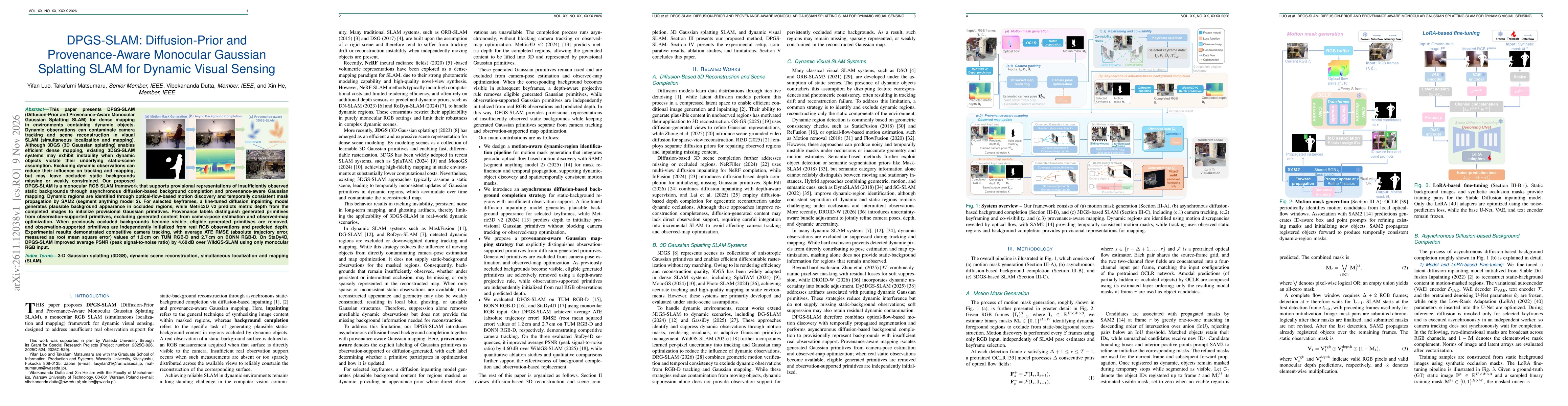
This paper presents DPGS-SLAM (Diffusion-Prior and Provenance-Aware Monocular Gaussian Splatting SLAM) for dense mapping in environments containing dynamic objects. Objects in dynamic motion remain a significant challenge for dense visual SLAM since dynamic observations can contaminate camera tracking and scene reconstruction. Although 3DGS (3D Gaussian splatting) enables efficient dense mapping, existing 3DGS-SLAM systems may exhibit instability when dynamic objects violate their underlying static-scene assumption. Excluding dynamic observations can reduce their influence on tracking and mapping, but may leave occluded static backgrounds missing or weakly constrained. Our proposed DPGS-SLAM is a monocular RGB SLAM framework that supports provisional representations of insufficiently observed static backgrounds through asynchronous diffusion-based background completion and provenance-aware Gaussian mapping. Dynamic regions are identified through optical-flow-based motion discovery and temporally consistent mask propagation by SAM2. For selected keyframes, a fine-tuned diffusion inpainting model generates plausible background appearance in occluded regions, while metric depth predicted from completed images initializes provisional Gaussian primitives. Provenance labels distinguish generated primitives from observation-supported primitives, excluding generated content from camera-pose estimation and observed-map optimization. When previously occluded backgrounds become visible, eligible generated primitives are removed, and observation-supported primitives are independently initialized from real RGB observations and predicted depth. Experimental results demonstrated competitive camera tracking, with average ATE RMSE values of 1.2 cm on TUM RGB-D and 2.7 cm on BONN RGB-D datasets. On StaDy4D, DPGS-SLAM improved average PSNR by 4.60 dB over WildGS-SLAM using only monocular RGB input.
Analysis
AI-generated · verify against the original paper
Generated Jan 1, 0001ResultsWhat the authors found
- Achieves average absolute trajectory error (ATE) RMSE of 1.2 cm on the TUM RGB‑D dataset.
- Achieves average ATE RMSE of 2.7 cm on the BONN RGB‑D dataset.
- Improves average PSNR by 4.60 dB on the StaDy4D sequences compared to WildGS‑SLAM using only monocular RGB input.
- Demonstrates competitive camera tracking performance while handling dynamic objects and providing provisional background reconstruction.
MethodologyHow the work was done
DPGS-SLAM integrates optical-flow-based motion discovery with SAM2 mask propagation to detect dynamic regions, then asynchronously applies a fine-tuned diffusion inpainting model to generate plausible background appearance for occluded areas. Metric3Dv2 predicts depth for the completed images, initializing provisional Gaussian primitives that are labeled with provenance tags distinguishing generated from observation-supported primitives. Generated primitives are excluded from camera-pose estimation and map optimization, and are removed when real observations become available, allowing dynamic‑aware monocular SLAM with dense Gaussian splatting.
SignificanceWhy the work matters
The work enables dense monocular SLAM in dynamic environments by filling occluded static backgrounds with diffusion‑based priors, thereby reducing tracking drift and map corruption caused by moving objects without requiring additional depth sensors.
Technical contributionsWhat the work introduces
Introduces an asynchronous diffusion‑based background completion pipeline combined with provenance‑aware Gaussian mapping, allowing provisional representation of insufficiently observed static regions while keeping generated content separate from pose optimization.
NoveltyHow it differs from prior work
First SLAM system to fuse diffusion‑prior inpainting with 3D Gaussian splatting and explicit provenance labeling to robustly handle dynamic scenes in a purely monocular RGB setting.
Discussion 0