DRA-HTR: Disentangling Representation and Adaptation for Handwritten Text Recognition
Abstract
Handwritten text recognition (HTR), particularly when applied to historical documents, remains challenging due to the scarcity of annotated data and the substantial domain shifts caused by variations in handwriting styles, document degradation, acquisition conditions, and linguistic characteristics. While large amounts of unlabeled target-domain data are often available, effectively exploiting them requires adaptation strategies tailored to the specific requirements of HTR. We propose DRA-HTR, an unsupervised generative domain adaptation pipeline specifically designed for HTR and built upon the DRANet framework. The proposed approach combines source-domain pretraining, unsupervised adaptation to the visual characteristics of the target domain, relying on the generation of target-style source samples for task-specific training. We further investigate the integration of post-HTR correction to complement visual adaptation with language adaptation, relying on large language models, which we introduce as DRAL-HTR. The proposed framework is evaluated across seven HTR datasets spanning four languages, using a single set of hyperparameters for all source-target combinations. The recognition model achieves state-of-the-art performance on four datasets and competitive results on the remaining three. In addition, the proposed DRA-HTR establishes a new state-of-the-art for domain adaptation across all seven datasets and substantially improves overall robustness and training stability compared to the original DRANet framework: it reduces the Character Error Rate (CER) in average by 13.52 percentage points, and the average standard deviation decreases from 7.23 to 1.11 percentage points. Finally, post-HTR correction further reduces the CER by 2.16 percentage points. Code is available at https://github.com/FIorentI/DRA-HTR-Disentangling-Representation-and-Adaptation-for-Handwritten-Text-Recognition.
Analysis
AI-generated · verify against the original paper
Generated Jan 1, 0001ResultsWhat the authors found
- The recognition model achieves state‑of‑the‑art performance on four out of seven HTR datasets and competitive results on the remaining three.
- DRA‑HTR reduces average Character Error Rate (CER) by 13.52 percentage points compared to the original DRANet and lowers the average standard deviation from 7.23 to 1.11 percentage points, indicating higher robustness and training stability.
- Post‑HTR correction (DRAL‑HTR) provides an additional CER reduction of 2.16 percentage points.
MethodologyHow the work was done
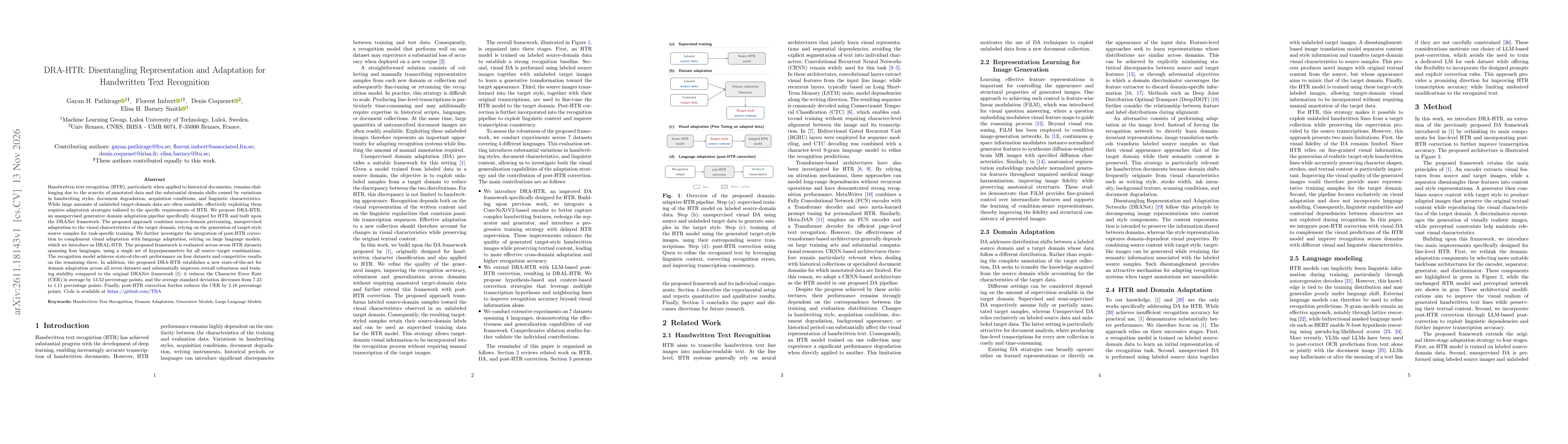
DRA-HTR is an unsupervised generative domain adaptation pipeline built on the DRANet framework. It consists of three stages: (1) pretraining an HTR model on labeled source-domain data, (2) performing visual domain adaptation by generating target‑style source images using a ConvNeXtV2‑based encoder, redesigned separator and generator with a progressive training strategy, and (3) fine‑tuning the HTR model on the generated target‑style samples. An optional post‑HTR correction stage (DRAL‑HTR) leverages large language models with hypothesis‑based and context‑based strategies to further improve transcription accuracy.
SignificanceWhy the work matters
The work demonstrates that disentangling visual representation learning from adaptation, combined with language‑model‑based correction, can substantially improve cross‑domain handwritten text recognition without requiring any annotated target data, advancing both robustness and practical applicability of HTR systems.
Technical contributionsWhat the work introduces
Introduces an improved domain adaptation framework for HTR that integrates a ConvNeXtV2 encoder, a redesigned separator and generator, and a progressive training schedule, plus a novel LLM‑based post‑HTR correction module.
NoveltyHow it differs from prior work
The paper uniquely combines unsupervised visual domain adaptation with large language model‑driven post‑processing in a single pipeline, and applies disentangled representation‑adaptation concepts to handwritten text recognition for the first time.
Discussion 0